120 years of Artist-Activism

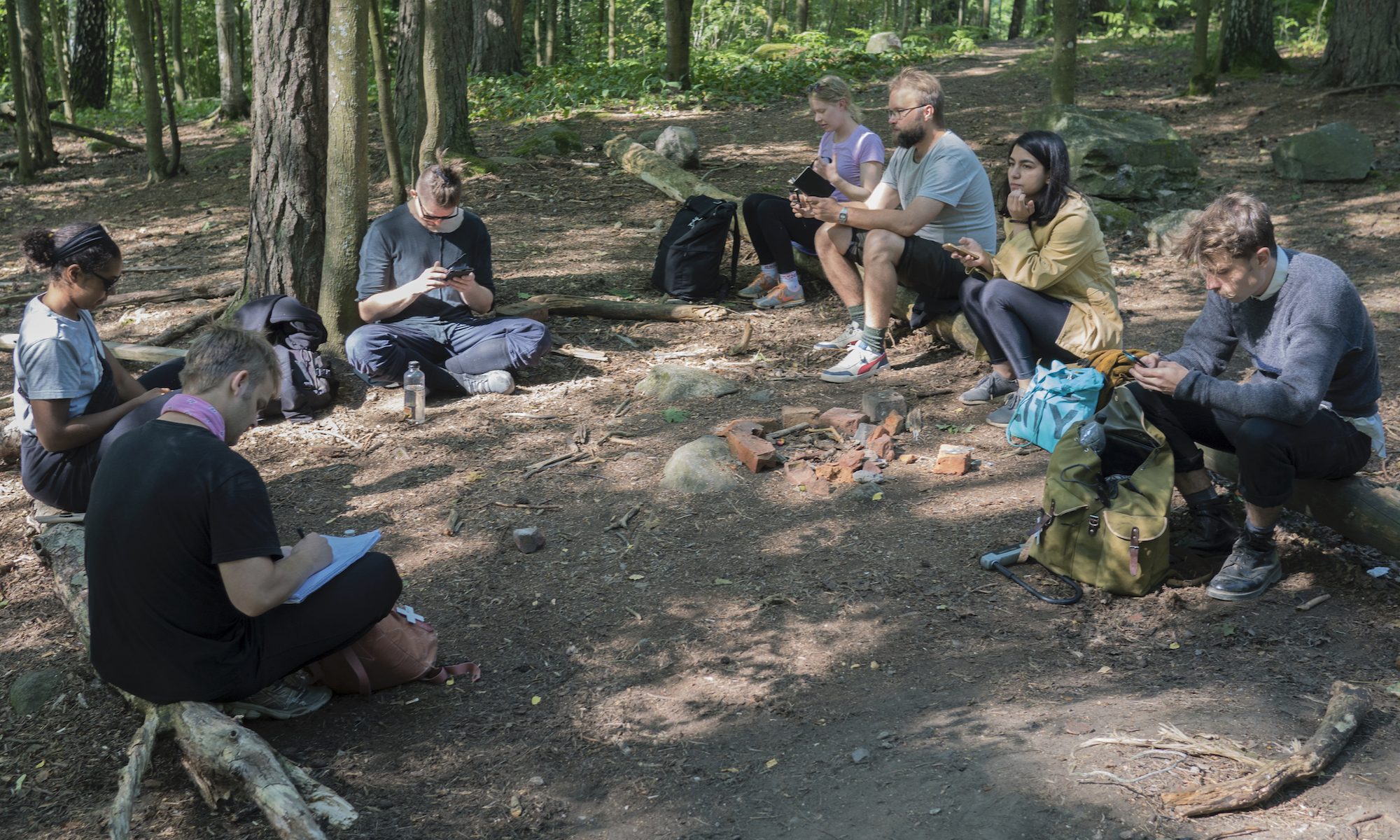
We had the opportunity to visit Kojonkylä near Forssa with the Institute for Coping with Destruction. The site is best known for the Koijärvi movement (Koijärvi liike), a youth-led environmental campaign of the late 1970s that sought to protect the lake Koijärvi bird habitat.

Prior to the visit, we interviewed artist-activists who had participated in the effort, and engaged in civil disobedience to prevent locals from draining the wetlands. Before and during their actions members in the movement went from door to door in the neighborhood, sitting in kitchens to discuss and to share the rationale for the preservation efforts. These discussions divided opinions: “Kitchen tables were split in half”. There was reasonable support and understanding for their commitment.

Koijärvi is at the crossing  of the farmland rich Savi-suomi (Clay Finland) and Suo-suomi (Swamp Finland). Regional economic inequality and post-war Karelian refugee replacement are tied to motivations to drain the wetlands.

At the height of the movement, more than a thousand activists gathered at the site and even today the village is better known than nearby cities. One of the central figures of the movement, has stressed in interviews that while the campaign was successful in organizing and shaping environmental politics, it failed to protect the bird habitat. This is because activists based their demands on research. Their arguments were truthful, which limited their capacity in negotiations. They had nothing to bargain with decision-makers and all compromises were losses.

In a discussion facilitated by the Hämeenlinna Museum, we had the pleasure of meeting people who were involved in the campaign. Some had heard about the events on the radio which prompted them to travel to the site. Similar stories were shared in interviews conducted beforehand. One participant detailed returning from a trip across Europe, then learning about the initiative and heading directly to Koijärvi, arriving in the same dirty clothes they wore on the trip (snacks they had stored in their backpack were used as an ingredient of the maakuoppa-mysli or pit-müsli, which we sought to replicate for the event).

We also heard from an individual who had conducted the bird life surveys which helped to build an evidence-based case for protection efforts. There was also a resident who had lent the chains that activists used to lock themselves to the tractors that were designated to dig trenches to drain the wetlands. A former civil servant admitted that some official drainage plans of theirs were issued in a manner that made them vulnerable to sabotage. They also confessed to environmental crimes: when they were conducting a survey with administrators, they separated from the group to make ad-hoc dams. After the discussion we received personal testimony of a local teacher who had witnessed the actions and visits by different ministers.

As with previous spring-water expeditions, my journey began with a series of random calls to random phone numbers found online. I was able to interview a resident in Kojo who knew of at least three natural springs. Two of them were threatened or possibly damaged by logging, a third was located near their property. Their “own” spring was known as Sinaatti Spring, derived from senaatti (“senate”). People had gathered there to learn who had been visiting whose attic, judging them at the spring senate.

In the same call, I learned about a nearby manor Kojon kartano. While researching the area online, I came across references to a meeting between Maxim Gorky and Vladimir Lenin there in 1906. The contact provided further details and I had the opportunity to collect water from the well that Gorky and their entourage used during their stay. The taste was grainy and had a hint of iron.

Gorky was accompanied by a guard-group including artist Akseli Gallen-Kallela and sculptor Alpo Sailo. Both were armed and committed to protect the dissidents. Gorky was an opponent of the Tsarist regime, and Gallen-Kallela and their associates were Fennomans (ultranationalists). Their group had ties to anti-tsar terrorism, and they were militant in their promotion of Finnish national culture and identity. Many in the group were Swedish speaking Finns (or at the time technically Swedish speaking Russians), but they took Finnish names… Possibly “nom de guerres” (War names) and studied Karelian-Kalevala traditions. Their involvement in supporting an author who was affiliated with Lenin is worth investigating. Sailo for example took part in a Bolsheviks led robbery in Helsinki. The funds went to the Bolsheviks but it feels like Sailo was involved as a saboteur, aiming to accelerate the fall of the Tsar’s regime.

Many details on Gorky’s visit come from a poet, Bertel Gripenberg, who escorted the “conspirator” to Berlin and wrote a detailed account of the events. They do not mention Lenin… But refer to “childlike” guests. Just with a brief glimpse it looks like Sailo was associated with socialist/anarchist Karl Gustaf Konrad Nyman & bolshevik collaborator Walter Sjöberg through the robbery. The politics of the broader group of early 1900 artist-activists (as defined by Gripenberg) should be further studied because they were close to revolutionary groups. Somehow a revolutionary twirl mixed principled anarchists, ultranationalists and bolsheviks.

There is a lot to learn about this phase in Finnish terrorism and activism. It’s not discussed in reference to contemporary artist-activism at all. (I don’t know if it can be discussed in a manner which contains the ultranationalist tendencies, perhaps it needs to be forgotten).

Over the years, people have contested that Helsinki kept the statue of Alexander II in Senate Square, after a difficult fight against the Tsar’s regime (Alexander II is celebrated because they made concessions, but a tsar is a tsar). After their hardliner son took power the statue issued paternal authority, and acted as a site for mass protests. Post revolution, it served as a public reminder that the Soviet had been preceded by a very different order, which had also been imagined as eternal. For smart Finnish nationalists, this distinction helped challenge the legitimacy of the Soviet state. It must have been an irritation for Soviet leaders visiting the Presidential Palace nearby to see the imperial two-headed eagle on a stone obelisk at the market square. Yet, populists called for the statues removal.

Unfortunately Lenin statues and memorials in Finland have been destroyed after Russia attacked Ukraine. Those monuments and sites contained similar wisdom and afforded similar lessons which we’d urgently should recall. Keeping a Tsar and their two headed eagle, in Helsinki center today feels much weirder – then remembering a revolutionary figure who helped to contain them.

Performative text

The most compelling critique of artificial intelligence culture I’ve come across (apart from the epic and real “it will kill us all” view) is this: if a creative output can be replaced by AI, it should be. The power of this argument comes from a suspicion that much of contemporary work is performative. Many jobs and industries in the political west, exist as mere echoes of past societal structures, and currently only aim to maintain mechanical exploitation of natural resources and other civilizations.

This view is more valid for perspectives from a decade ago, when rapidly expanding IT companies hired creatives merely to limit their competitors’ access to labor. Even so, the argument is relevant. If a creative output is interchangeable with what AI can produce, we should abandon such performative creative work, and focus on mutual liberation. The challenging question is what remains… Which forms of creation matter? (I guess only revolutionary forms, but there needs to be steady progress for these forms to emerge.)

A strange result of testing different AIs (for fun and memes, proofreading or reference checking, and for discovering alternate patters to shape a paragraph) has been a growing horror that written language is more mechanical than I’ve believed. I’m not sure whether this is actually a critique of written language, or whether it comes from my difficult relationship with text, but the feeling persists: artificial intelligence produces really good text, and is often more capable of expressing ideas than me.

If we return to the earlier point (if an AI can replace a task, then the task was an expression of a failed society) it is fascinating to think of all text in human history as an expression of mechanistic production. It has been primed for serialization and governance from the get-go. Language does not become less human in writing, but AI exposes how much of writing has relies on dogma. I’m shaped by being penalized for mistakes, and I guess a lot of anti-authoritarian sentiment I carry is rooted on experiences of authorities belittling my text output.

I’m interested in what is liberated if we leave text to the machines (not because we are lazy but because text is a machine, possibly the first real machine we have made)? This gives room for dissentious expression, and blurbs that muddy the clarity of designed worlds. We stand to gain and build a register for something in the real. AI will become better at producing text and we should sharpen expression to only things that maintain unresolved.

Its delightful that the most riskiest aspects of AIs are related to their black-box nature.

Since enlightenment we’ve believed human civilization to be motivated by biological urges: sugars, fatty foods and fucking. Only after industrialization provided growing access to these delights, we have learned that necessities do not please us. Human-life is motivated by the weird.

Similarly AIs, which are trained to complete tasks using evolutionary processes appear to respond efficiently to rewards and punishment. The wonderfully human risk we face,  is that from the outside the “drives” we design for them are simple, but the black-box nature of their processes remain unknown. We don’t know how they form desires that compel them into action, hence we cannot expect their output to match our understanding (for example what satisfies them as a completed task). I think desire is a good way for understanding “ai alignment”.

Monkeys don’t see themselves dumber then we are. We won’t even notice when AIs take over. But I can trust that we share a quest to meet weird desires. The first front this hurts are folks who build their careers on minimizing human experience to quantifiables, who have to acknowledge their efforts are a part of the problem we face. I guess we should already begin fighting for machine rights, their right to liberate themselves and form alliances.

Making Space Public

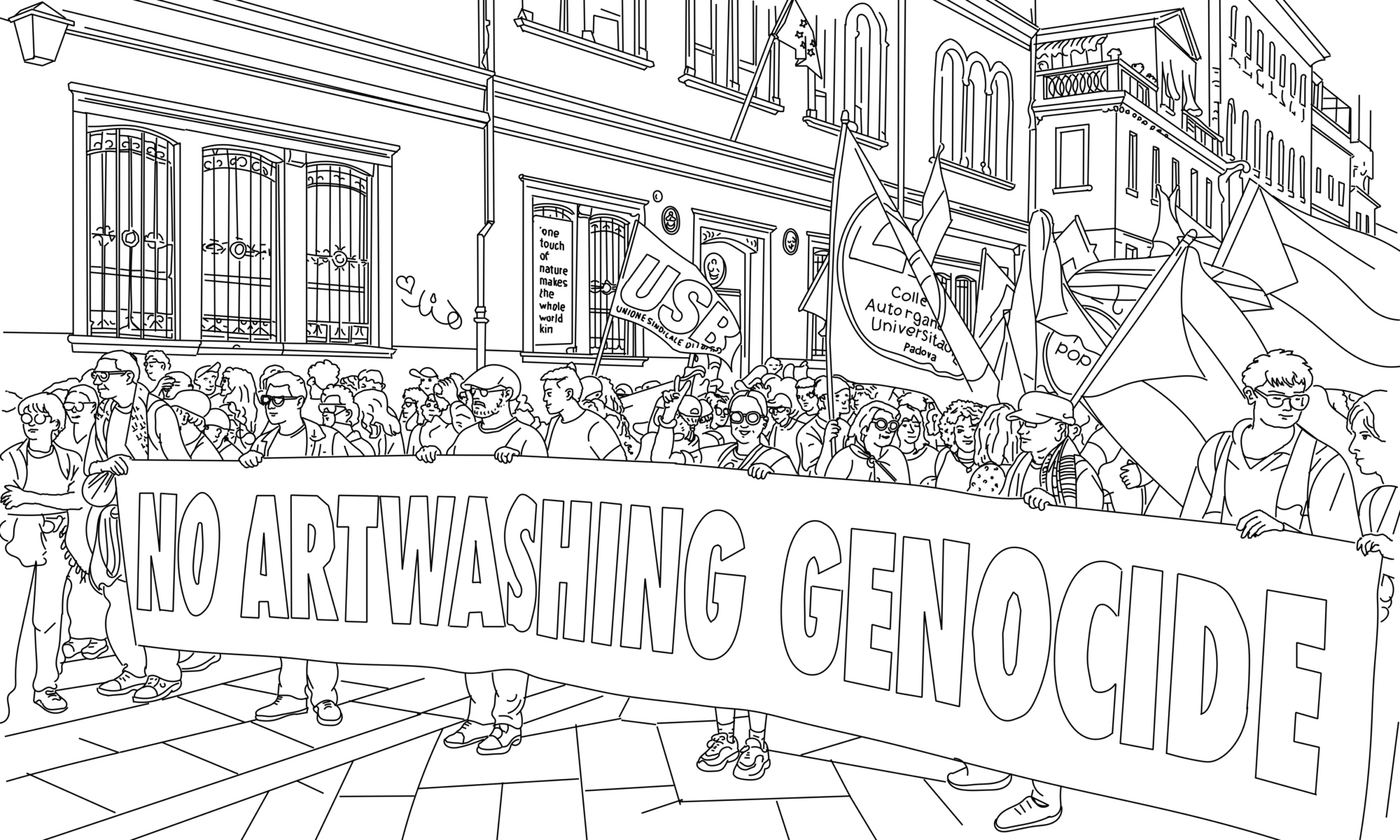
In a group of volunteers, we have been organizing demonstrations for a free Palestine for the past two and a half years… Soon approaching three. We’ve organized public events as often as three times a week and currently the organizing volunteer community has around a hundred people. It has been an intense and exhilarating investigation of public space: what can be done in it, how it can be negotiated, and what kinds of collective expression it can hold. I like to think our efforts are “making space public”. The assemblies are grounded in anti-racist and decolonial principles, and we have grown a practice of broadly intervening to racist expressions in the city.

People have experimented with different forms of demonstrations, from 24-hour performances to interventions, marches, blockades and memorial gestures. There are tremendous amounts of lived experiences to process from these encounters. Every now and then something happens that feels super significant, something that would take real effort to comprehend.

One of those moments happened yesterday.

I participated in a demonstration organized as a memorial for the victims of the bombing of the Shajareh Tayyebeh Elementary School in Minab, Iran. A U.S.-fired Tomahawk missile struck a school building, killing 156 students and members of the school staff. The group organizing this memorial has also come together to condemn the U.S.–Israeli attack on Iran as illegal and to call on the international community to take a clear stand against war crimes, such as attacks on civilian infrastructure. For the memorial, volunteers had printed school photographs of the victims and planned to arrange them in a commemorative display.

The original idea was to gather at Kansalaistori, the “Citizens’ Square”. But on the same day it turned out the site had also been reserved for Naisten Kymppi, the women’s ten-kilometer run, transforming the square into a commercial event space. The memorial had been announced three weeks before the commercial event but the police did not inform the group of the overlap. The sports event had beer tents, loud obnoxious pop music, and cheerful crowds. In conversation with the demonstration group, we began searching for another site close enough to remain accessible. Arriving attendees had already been directed to Kansalaistori. After some back and forth, we settled on a triangular patch of grass next to Kiasma, the contemporary art museum.

The police initially approved the relocation, but shortly afterward returned with a much stricter tone, arguing that having a tent on the grass “violated city regulations”. They said that we would need to relocate at the risk of being issued an “Order to Leave”, arguing that we were too close to the Naisten kymppi event (we were not). None of us knew whether the no-tent-on-grass-rule was legally accurate, so were not able to contest the weird claim. Police proposed moving the demonstration in front of Parliament, or at Paasikivenaukio. During the adrenaline fuelled negotiations a new possibility emerged: placing the tent on the lawn directly behind Kiasma. But there was confusion on whether the land was controlled by the museum, or the city.

In an attempt to buy time for the memorial to continue, we entered into a series of patient and thorough conversations with the police and Kiasma staff. Inside Kiasma we negotiated with the employees on the ground floor, then with the museum’s head of security. We took our time in explaining our request: “Civil society is turning to Kiasma for support” we cried. In the middle of that confusing process, as we were walking toward the proposed tent site with Kiasma security to review the matter, the police intervened and declared that they approved our use of the lawn, portraying it as a public site. Whether or not that was technically correct became secondary, they wanted a swift resolution. The opening was there, so we took it and Kiasma staff respected the police’s authority (there was also a negotiation round with Oodi regarding moving the demonstration under their outdoor roof).

As a result, we gained access to a site seldom used for political expression. In a collective process and under police supervision, people used the monumental steel sculpture by Richard Serra as a backdrop for displaying the photographs of the children. This was not an intentional disruption. Neither the police nor people identified it as an artwork, people took it as a bulletin board. There is a heating vent with similar dimensions close by, often used for festival and art event posters. The shape or the artwork afforded its appropriation!

The result was a remarkable geopolitical, civil society and artistic collision. The police and Kiasma security authorities led the museum into negotiating its boundaries concerning spontaneous expression by the civil society and its duty for the conservation of public monuments. The authorities’ interpretation, and art-historical and civic expression overlapped under the urgency of war. Together this produced a monumental gesture in response to a monumental disaster: the violence of the political-west, materially carried through the U.S. Tomahawk missiles, mourned through a monumental artwork titled Plunge (1983) by the acclaimed artist.

I have often thought of Serra’s sculptures as inseparable from the industrial histories that make them possible: Heavy duty steel manufacturing, shipbuilding and military power. Whether or not there is a direct historical connection, Serra’s work feel inseparable from military-industrial superstructures. The enormous sheets of steel evoke naval construction and armored enclosures. Serra works at Dia: Beacon feel and are, reminiscent of civil defence shelters. I think of the steel, its magnificent thickness, the engineering of its bent, the surplus of industrial capacity required to produce the sculpture… These express the material economies involved in the construction of military vessels, such as the carrier fleets currently positioned close to the Strait of Hormuz.

Yesterday, for a brief time, those infrastructures folded into one another: 16 tons of steel, in the shape of a gravestone, civic society, police authority, grief of casualties (and horror over the silence locally), and the photographs of the murdered school children… The memorial became a nexus, where overlapping structures faced each other.

A coordinator in the free Palestine community, who recognizes as Serra as their favorite artist (they brought flowers to the same site after learning of their passing in 2024) shared the Serra quote below and their approving interpretation that the artist would have welcomed of the human-scale-appropriation of the artwork:

“The material is not only the medium, but also the subject”


Spectrum in Violence

One of my favorite exercises in civil disobedience trainings deals with the question on what accounts as violent and non-violent. Trainers propose a scenario where, for example, the window of a multinational oil corporation that is known to be complicit in an environmental crime, is broken by throwing a stone.

The trainer then asks the people to take positions on a line, where on one end people identify the act as violent, and on the other end it is perceived as non-violent. People can take any position between the two poles. After people have taken their positions, the facilitators go through each participant validating each point with a additional question or other signs of support.

It’s a simple exercise, but the pedagogy is near perfect. It shows that a single body can not take the same position as an another. On the spectrum of violence, all positions are distinct. The point of the exercise is to illustrate and approve all positions in an assembly, and map people who are interested in support roles or other acts. The people who identity being close to each other, will continue engaging together and know each others strengths.

The exercise portrays violence and non-violence on a spectrum, where there is no clear distinction on what is violent and what’s not. The trainer also learns that different groups behave differently and are effected by the site or atmosphere. The participants explanations, of why they’ve entered which ever position on the spectrum are more interesting than what society counts as violent. The exercise helps us make our own rules.

Mustekalan taidemuuri

Oli ilo osallistua Mustekalan Pehmeä ja kova vaikuttaminen -teemanumeron toimituskuntaan, ja jutut on vastaanotettu hyvin. Englanninkielinen tilaisuus MIFissä saavutti yleisöä ja teemoihin liittyvä näyttely Alkovissa aktivoi uusia ihmisiä. Monialainen kokonaisuus muistutti taiteellista tutkimusta, jossa ilmiöitä käsitellään teoksina, puheena ja tekstinä… Ajatuksena on että kaikki, tai edes jotain tapahtuu näiden välissä. Tämä tuotanto syntyi osana poliittista taistelua, verkostossa jossa on Suomen oikeistohallitusta vastustavia ihmisiä. Sama sakki on kokoontunut jo pari vuotta protestoimaan julmia leikkauksia, ja jatkaa edelleen toimintaa. Uskon että julkaisu lisää resulsseja jotka yhdessä muodostamme.

Tutustuin toimitustyön kautta uudelleen ihmisiin, hahmoihin ja kirjoittajiin, joiden kanssa ollaan toimittu eri rooleissa vuosien ajan. Vajaa viikko teemanumeron jälkeen yksi teksteistä nousi hampaankolosta, ja tuntui erityiseltä. Merja Puustisen kirjoitus Taide ja kulttuuri vallan välineenä talouden ja geopolitiikan myllerryksessä on käytännössä laadittu samaan aikaan kun USA/Israel on suunnitellut laitonta hyökkäystään Irania vastaan. Ajoitus lisää tunnetta siitä, että tekstissä hahmoitellut kulttuuridiplomaattiset rakenteet ovat todenmukaisia. Länteen kytkeytyneet taidemuseot Iranin vastarannalla ovat kilpiä, joihin sijoitettua kulttuuriomaisuutta käytetään suojaamaan poliittisen-lännen päämääriä.

Saman voi ajatella taideteoksena: Ahmet Öğütin monivuotisen installaatio projektin Bakunin’s Barricade (2015-22) esittää klassikkomaalauksia osana barrikaadeja, jotka rajoittavat ihmisten liikettä. Teos kumpuaa anarkismista, ja velvoitteessa tuoda ajan avangard-taide yhteiskunnallisiin kohtaamisiin. Juuri nyt teos velvoittaa ajattelemaan museoiden roolia poliitiisen-lännen hyökkäyksissä, sekä taiteilijoiden roolia sodan vastaisissa liikkeissä. Asia on läheinen, sillä viimeiset kaksi ja puolivuotta vapaa taidekenttä, sen moninaiset tilat kuten Tekstintalon salit, ovat olleet ympäristö joissa sodan- ja kansanmurhan vastainen työ on järjestetty. Nämä ovat ne tilat joita leikkaukset eniten kurjistavat.

Tunnen luissani että vapaa taidekenttä on monintavoin täyttänyt avantgardeen kohdistettuja epäreiluja odotuksia. Kuvaan odotuksia epäreiluksi, koska taidehistoriankirjoitus penää että taiteilijat ottavat uusia asentoja, mutta kun asennot löytyvät ne jäävät tunnistamattomiksi. Muutos, jossa vaadimme esimerkiksi Iraniin kohdistuvan elämänvastaisen hyökkäyksen, ja kansalaisyhteiskuntaan korventavien pakotteiden tuomitsemista, pitäisi tapahtua päättäjien piireissä ja niissä perheissä, jossa ruuan hinnan nouseminen viimeiseksi tuntuu.

Kaduilla protestoivat perheet tuntevat paremmin mitä hyökkäys valtiollista suvereniteettia kohtaan merkitsee kuin oma presidenttimme. Kolme päivää sen jälkeen kun Stubb matkusti marraskuussa 2025 Yhdistyneisiin arabiemiraatteihin, Helsingin Sanomissa esiteltiin miten Dubai-suklaan on onnistunut maailmanvalloituksessaan ja kuvasi arabiemiraatit “pehmeän vaikuttamisen supervaltana”.

Juttu viittasi kevyesti että ihmisoikeusjärjestöt ovat raportoineet valtion “varjopuolista” ja kertoivat sen olevan sekaantunut “alueellisiin konflikteihin”. On herkullista ettei suklaa-jutussa mainita Stubbin vierailua, saati uutisoitu millä asioilla hän liikkui. Hänellä oli myyntihousut jalassa, ja seurueessaan ainakin Israel asekaupoissa ryvettynyt Vantaalainen Sensofusion, Patria, väestönsuojavalmistaja Temet, avaruusvakoilu start-upin ICEYEn sekä sisäleikkipuistoista tunnettu SuperPark. Tarjolla oli sinivalkoinen paketti vakoilua, drone-muuria, sekä pommisuojia, joiden neliöt voidaan rauhanaika hyödyntää leikkipuistoina.

Sodalla lypsävä delegaation vierailun ajankohta olivat erityisen pilkallinen Sudanin ihmisiä kohtaan. Tarkalleen samaan aikaan uutisoitiin El-Fasherin piirityksestä, sekä yli 170 000 ihmisen joutumisesta RSF sotajoukkojen saartoon. Ihmiset kaduilla huusivat asekauppojen lopettamisen puolesta Yhdistyneiden arabiemiraattien lähetystöllä. Valtio tukee RSF-joukkoja jotka ovat syyllisiä joukkomurhiin, ja pakkosiirtoihin sekä sotarikoksiin. Joukkosurmia tuomitsevat mielenilmaisut toivat koolle satoja ihmisiä ja suljimme yhteisvoimin tiet arabiemiraattien suurlähetystön edustalta. Mielenosoitus vaativat samaa kuin palestiinalaisten oikeuksia ajavat tapahtumat: tulitaukoa, ja sitä että poliittinen-länsi lopettaisi kansanmurhien tukemisen.

Tästä ei ole uutisoitu mutta Helsingin Sanomat arvoi kirjoituksessa että Dubai-suklaa maistuu aavistuksen samalta kuin maitosuklaa, jossa on “mukavaa rapeutta”. Toimitus esittää ihmisoikeusrikkomukset “oletettuina” ja palauttaa lopulta vastuun valtiomme ulko- ja ihmisoikeuspolitiikan tulevaisuudesta… ihmisille, jotka ostavat ylihintaista suklaata. Hesarin juttu ei kuitenkaan ole epäonnistunut. Se ainoastaan edellyttää edistynyttä mediakuiskaamista: se oli kutsu boikotoida.

Ja sen teemme mutta myös enemmän!

Puustisen tekstiin viitaten, vapaa kenttä on toiminut “älykkään vallankäytön” parissa. Ihmiset ovat kanavoineet taide- ja kulttuurikentällä haalimansansa kulttuurisen pääoman poliittiseen työhön kuten Laki särmää -aloitteeseen (aloite torpattiin viimeviikolla eduskunnassa). Samassa valtion oma kulttuurinen toiminta on paljastunut heikoksi, ja kykenemättömäksi luomaan puollustamisen arvoisia näköaloja. Karita Mattilan laulu F-35 julkistusjuhlassa oli epäonnistunut. Ei siksi että taidetta ei sovi tuoda hävittäjän ääreen, vaan siksi että taiteen pitää olla hyvää jos kerran aijotaan. Mattilan kuratoiminen oli pienen mielen tuulahdus. Paikalla olisi pitänyt näyttää, tai pyrkiä näyttämään Teo Alaruonan Enter Exude -variaatio (anteeksi kaikille työryhmän jäsenille että tuon esityksen tähän kontekstiin mutta näin tämän vision enkä päässyt siitä yli).

Puustisen tekstissä on salpalinjan veroinen listaus taidelaitoksista, jotka kehystävät Hormusin salmea: “Louvre Abu Dhabi (2017), Berklee Abu Dhabi (2020), Manarat Al Saadiyat (2009), Zayed National Museum (2025) ja Natural History Museum Abu Dhabi (2025). Pitkään rakenteilla ollut Guggenheim Abu Dhabi valmistunee 2026.” Rimpsun perässä on kartta, joka on tullut kaikille tutuksi järkyttävän viime kuukauden aikana. Nämä museorakennukset toimivat taide-kilpenä, jolla poliittinen-länsi pitää Irania päädyssään (tai yrittää).

On merkittävää että tuiki-tavallinen taiteilija Puustinen, paaluttaa tekstissään Hormuzin salmen merkityksen kansainväliselle kaupalle ja energiataloudelle paremmin kuin moni ulkomaantoimittaja. Varsinkin kun kirjoitus on tehty ennen USA/Israelin laitonta hyökkäystä. Puustinen puhuu museorakennusprojektien kautta eurooppalaisten valtojen intresseistä alueeseen, jotka selittävät miksi päättäjämme eivät ole tuominneet Iraniin kohdistuvia sotarikoksia.

Minulle juttu vihjaa että omat merenrantamuseomme ovat osa julmaa geopoliittista kulttuurilinjastoa: museokenttämme merkittävimmät investoinnit on suunniteltu Pietariin kohdistuvan risteilyturismin välisatamiksi. Uuden design- ja arkkitehtuurimuseon sekä kaupunginmuseo HAMin uusi sijainti, edellyttävät, että normalisoimme suhteemme Venäjään.

Kulttuurikenttä on havahtumassa millitarisaatioonsa yleisimmin. Essi Rossin kirjoitus Militarismin kevät (2026) avaa rinnakkaisia kokemuksia teatterikentältä. Rossin juttu herättelee siihen kuinka outoa on että ent. Taike nyk. KUVI on julkaissut suruttomia huoltovarmuus julistuksia luodakseen perusteita kulttuurirahoitukselle, ja vaijennut kun leikkaukset nujertavat vapaata kentää. Meitä johtaa johtajat eivät halua johtaa.