
Ducking effect with what I have: TTLFO Clock -> Turing Machine Clock, Pulse Out -> Divider 1&2, 1 -> Rampage IN A, OUT A -> Inverter IN, OUT (This inverts the Ramp. positive env.) -> Sense (V)IN (preamp low & DC, set “ducking amount” by toggling OFFSET and preamp), CV OUT + (This lifts the volume to desired level in VCA, which inverted Ramp. signal pulls down) -> Skis VCA CV IN (Signal IN for the drum sound to be ducked). Divider 2 -> Skis TRIGGER IN (Signal IN for the sound which moves above ducking). Other: Ramp. RISING OUTs work great for vactrol LPG controlled hihats (White noise), TTLGO OUT (with square & Ramp. controlled SHAPE) -> Floating GATE to TRIGGER -> Multicassa Trig IN works great for dynamic percussion. Short experiment with the setup.
20200721
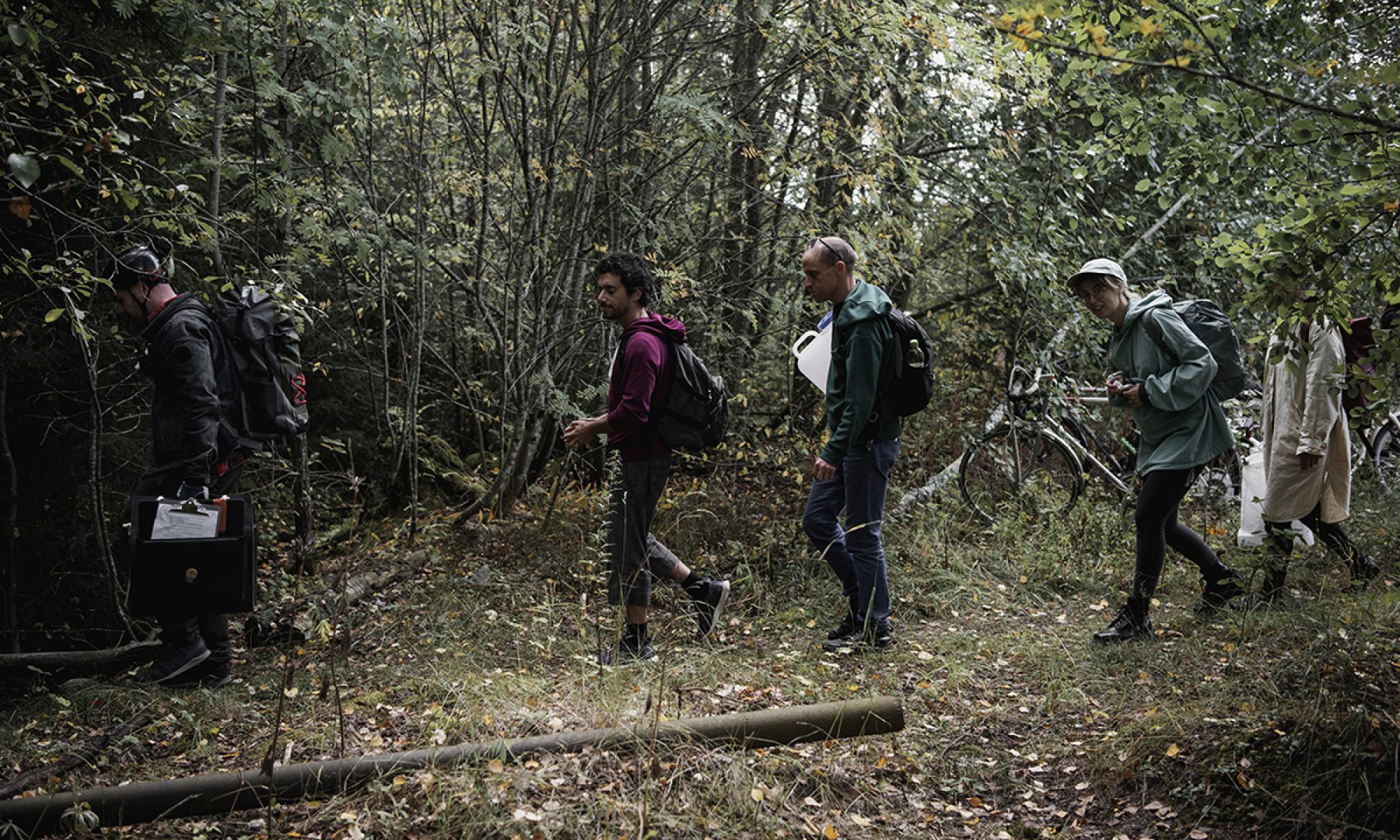
The Broända spring seems to be destroyed. We visited the site (60.22312, 25.12607) yesterday and after a careful inspection of the surroundings it seems that the landscaping of the creek and the construction of the Vartiokylänlahti floodwalls have resulted into the destruction of the natural spring. I found a well in the proximity but it was dry. A survey Helsingin kaupungin ympäristökeskuksen julkaisuja 17/2013 (which Emmi found online) offers a thorough listing of all of the springs in Helsinki. According to this source the Broända spring (also know as “Viking Well”) was the best source for natural water in the city. The destruction of the spring is also confirmed on this blog and by browsing the history of the site on Helsinki ilmakuvina 1932–2014 service. Marko Leppänen has published a comment on a blog (summer, 2015), which details that a concrete rim of the spring well had been damaged by landscaping equipment.
We continued our expedition to the nearby Kurkimoisio spring, which according to the available photos seemed to be in the same condition as during the 17/2013 survey. As mentioned in the survey there were old wooded ground structures (dams?) in its proximity and I think more them were visible then before. The concrete ring placed around the spring opening was poorly covered and it had collected organic material. I tasted the water, it was drinkable but the water was discolored and had an odor. This spring would be great for a restoration project! We also strolled in the Kurkimoisionpuiston creek-spring area but no surface springs could be spotted. Apparently Helsinki area underground waters are not used as supplies for drinking water but there are facilities around the city tapped to the underground reserves, in case something goes wrong with the Päijänne Water Tunnel or the Silvola artificial lake (these are the water supplies for a million people). We spotted an odd facility named Broändan pohjavesilaitos near to the springs.
2020020
A selection of the Trans-Siberian Railway -Sound Archive is now available on Freesound. There are 35 clips (1.7gb) and I think the gps data mapping of the recordings alone tells a nice story. I’ve included Helsinki as a part of the Trans-Siberian railway network… As it was intended when the Tsar had our rails build. The archive would work great as background noise for a train-story/documentary or for train themed games. I think some clips might work as chopped samples too. The indexing of the files is a bit messy but there are real gems in the mix. My favorite clips are:
- Break check at a station (chopped samples). https://freesound.org/people/ldezem/sounds/528237/
- Distant Russian trap music (rap background or intro). https://freesound.org/people/ldezem/sounds/528230/
- Bathing upright in a train toilet (documentary). https://freesound.org/people/ldezem/sounds/519470/
- Train cabin by night, wheels grind (unique melody of rails). https://freesound.org/people/ldezem/sounds/511306/
I’m listening to them while writing and I can feel the sounds vibrating my phone, which makes the clips feel material, like thin peals of the trip. Miinas note that the archive is linked with geology (or the process of harvesting geological samples for profit) feels acute. I like that the samples have interference sounds and occasionally my hands can be heard touching the mic. The interference makes the surrounding medias physical, it shows the limits of the recording technology and adds to the appeal. There is a clip were the microphone passes an x-ray machine for example. The material disturbances make me think of Viktor Toikkanen when he pushed his laptop to memory overload glitch territory when live-coding.
Our In Various Stages of Ruins exhibition series continues at Alkovi. The current exhibition titled Toxicity will be build gradually through the end of the summer towards the fall. Currently there are photos from the Town of Asbest on display, my humble C-Cassette recording we made with Jesse titled Two Men Coughing in the Woods (2020) and a set of DIY orthopedic supports I made for my feet (mentioned earlier).
20200719
Assisted Riikka Kuoppala with her Vegan & Legal service yesterday. I offered mineral waters and chatted people up as her assistant. We worked in the Dallapé park and at Harjutori. I had fun and got an insight to Kuoppala’s project. I think, as an artwork Vegan & Legal is great for illustrating the technical and esthetic framework law is embedded to. The default look of law is gray and masculine.
Witnessing Riikka talk about law in a public park, wearing plain clothes and offering legal guidance, while serving kombucha felt oddly disturbing. This is because I’m not used to see law discussed in a comfortable setting and I’m not used to sympathize with people who work with it. All my dealings with law have been oppressive and violently bureaucratic. I hate everything about it, from the architecture of courts, all the way down to the the ugly sandwiches they serve in cafeterias.
On a practical level it was heart-warming to see Riikka offer legal guidance for free. Some had reserved a session and send her detailed questions to look up in advance. I think Vegan & Legal succeeds in making law more accessible and I hope this will encourage people working with law to work more publicly in the future.
20200716
Build a floating passive low pass gate with tone control (followed tips from here) but added 1k resistors to all inputs/outputs. Assembled my own vactrols, following a Animodule guide (I think I used a VT935G LDR and a Kingbright L-424IDT). Made a few passive floating attenuverters and passive gate to trigger plugs, following a partial schematic by Ken Stone. Might go for a Voltage combiner next. Yan Proefrock has published collection of passives. I wish I had learned of The Klangorium by Elliot Williams five years ago, build it and resolved my curiosity with electronics. It’s a Lunetta style system which seems to fit my desires.

Minua ei kiinnosta valkoinen etuoikeutesi [I don’t care about your white privileges] (2020) Sean Ricks. A great responce to the wave of reactive announcements of solidarity Finnish culture organizations published during the first waves of the Black Lives Matter movement. As Ricks points out many of the announcements are hollow because people working for these organizations are not actually willing to denounce their privileges. I would take Ricks critique even further and argue that many of the announcements are preemptive manoeuvres aimed to deflect further enquiries.