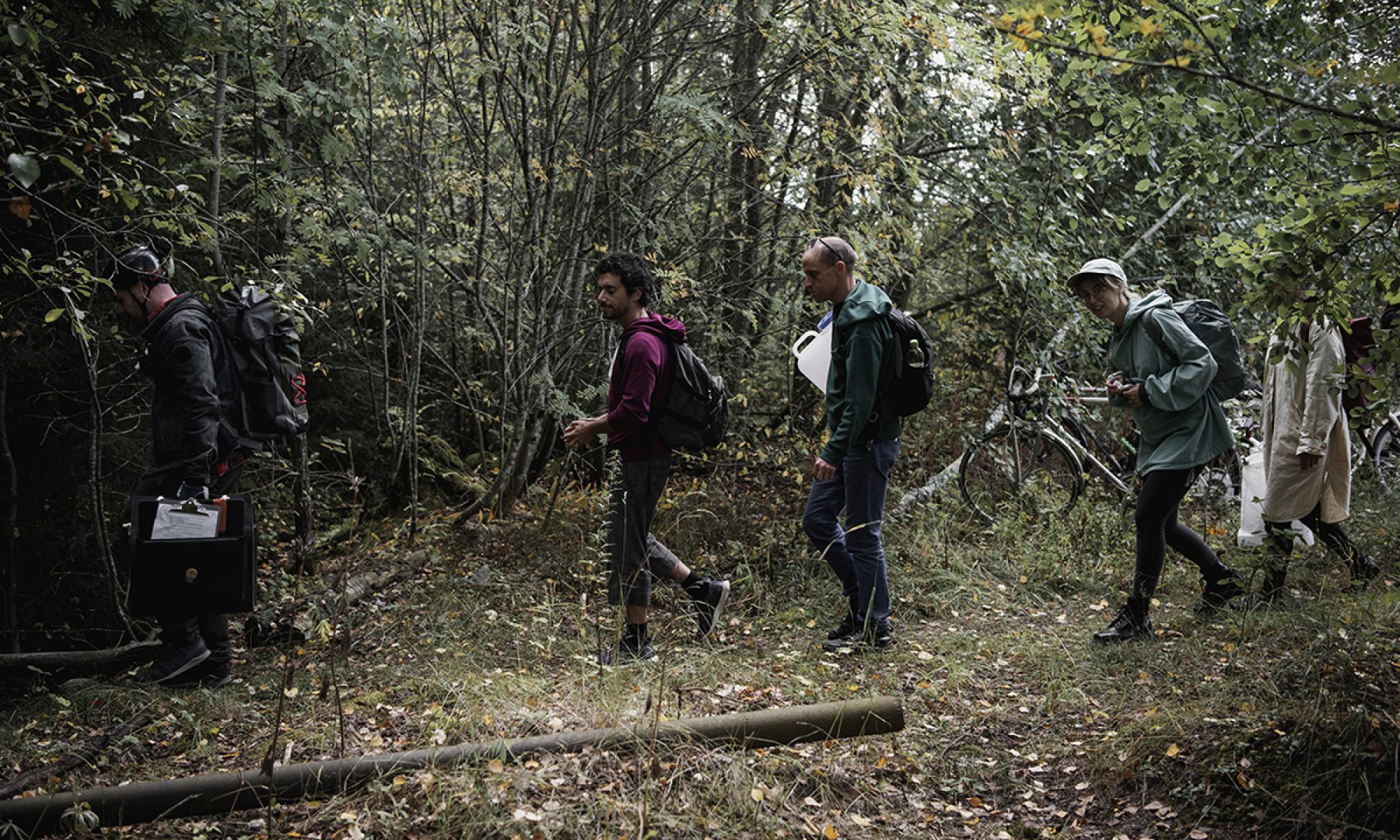

We had the opportunity to visit Kojonkylä near Forssa with the Institute for Coping with Destruction. The site is best known for the Koijärvi movement (Koijärvi liike), a youth-led environmental campaign of the late 1970s that sought to protect the lake Koijärvi bird habitat.
Prior to the visit, we interviewed artist-activists who had participated in the effort, and engaged in civil disobedience to prevent farmers from draining the wetlands. Before and during their actions members in the movement went from door to door in the area, sitting in kitchens to discuss and to share the rationale for the preservation efforts. These discussions divided opinions: “Kitchen tables were split in half”. There was reasonable support and understanding for their commitment.
Koijärvi is at the crossing of the farmland rich Savi-suomi (Clay Finland) and Suo-suomi (Swamp Finland). Regional economic inequality and post-war Karelian refugee replacement are tied to motivations to draining efforts.
At the height of the movement, more than a thousand activists gathered at the site and even today the village is better known than nearby cities. One of the central figures of the movement, has stressed in interviews that while the campaign was successful in organizing and shaping environmental politics, it failed to protect the habitat. This is because activists based their demands on research. Apparently their arguments were truthful, which limited their capacity in negotiations. They had nothing to bargain with decision-makers and all compromises were losses.
In a discussion facilitated by the Hämeenlinna Museum, we had the pleasure of meeting people who were involved in the campaign. Some had heard about the events on the radio which prompted them to travel to the site. Similar stories were shared in interviews conducted beforehand. One participant detailed returning from a trip across Europe, learning about the initiative and heading directly to Koijärvi, arriving in the same dirty clothes they wore on the trip (snacks they had stored in their backpack were used as an ingredient of the maakuoppa-mysli or pit-müsli, which we sought to replicate for the event).
We also heard from an individual who had conducted the bird life surveys which helped to build an evidence-based case for protection efforts. There was also a resident who had lent the chains that activists used to lock themselves to the tractors that were designated to dig trenches to drain the wetlands. A former civil servant admitted that some official drainage plans of theirs were issued in a manner that made them vulnerable to sabotage. They also confessed to environmental crimes: when they were conducting a survey with administrators, they separated from the group to make ad-hoc dams. After the discussion we received personal testimony of a local teacher who had witnessed the actions and visits by different ministers.
As with previous spring-water expeditions, my contribution to the journey began with a series of random calls to random phone numbers found online. I was able to interview a resident in Kojo who knew of at least three natural springs. Two of them were threatened or possibly damaged by logging, a third was located near their property. Their “own” spring was known as Sinaatti Spring, derived from senaatti. People had gathered there to learn who had been visiting whose attic, judging them as in a senate.
In the same call, I learned about a nearby manor Kojon kartano. While researching the area online, I came across references to a meeting between Maxim Gorky and Vladimir Lenin there in 1906. The contact provided further details and I had the opportunity to collect water from the well that Gorky and their entourage used during their stay. The taste was grainy and had a hint of iron.
Gorky was accompanied by a guard-group including artist Akseli Gallen-Kallela and sculptor Alpo Sailo. Both were armed and committed to protect the dissidents. Gorky was an opponent of the Tsarist regime, and Gallen-Kallela and their associates were Fennomans (ultranationalists). Their group had ties to anti-tsar terrorism, and they were militant in their promotion of Finnish national culture and identity. Many in the group were Swedish speaking Finns (or at the time technically Swedish speaking Russians), but they took Finnish names… Possibly “nom de guerres” (War names) and studied Karelian-Kalevala traditions. Their involvement in supporting an author who was affiliated with Lenin is worth investigating. Sailo for example took part in a Bolsheviks led robbery in Helsinki. The funds went to the Bolsheviks but it feels like Sailo was involved as a saboteur, aiming to accelerate the fall of the Tsar’s regime.
Many details on Gorky’s visit come from a poet, Bertel Gripenberg, who escorted the “conspirator” to Berlin and wrote a detailed account of the events. They do not mention Lenin… But refer to “childlike” guests. Just with a brief glimpse it looks like Sailo was associated with socialist/anarchist Karl Gustaf Konrad Nyman & bolshevik collaborator Walter Sjöberg through the robbery. The politics of the broader group of early 1900 artist-activists (as defined by Gripenberg) should be further studied because they were close to revolutionary groups. Somehow a revolutionary twirl mixed principled anarchists, ultranationalists and bolsheviks.
There is a lot to learn about this phase in Finnish terrorism and activism. It’s not discussed in reference to contemporary artist-activism at all. (I don’t know if it can be discussed in a manner which contains the ultranationalist tendencies, perhaps it needs to be forgotten).
Over the years, people have contested that Helsinki kept the statue of Alexander II in Senate Square, after a difficult fight against the Tsar’s regime (Alexander II is celebrated because they made concessions, but a tsar is a tsar). After their hardliner son took power the statue issued paternal authority, and acted as a site for mass protests. Post revolution, it served as a public reminder that the Soviet had been preceded by a very different order, which had also been imagined as eternal. For smart Finnish nationalists, this distinction helped challenge the legitimacy of the Soviet state. It must have been an irritation for Soviet leaders visiting the Presidential Palace nearby to see the imperial two-headed eagle on a stone obelisk at the market square. Yet, populists called for the statues removal.
Unfortunately Lenin statues and memorials in Finland have been destroyed after Russia attacked Ukraine. Those monuments and sites contained similar wisdoms and afforded similar lessons which we’d urgently should recall. Keeping a Tsar and their two headed eagle, in Helsinki center today feels much weirder – then remembering a revolutionary figure who helped to drain their power.