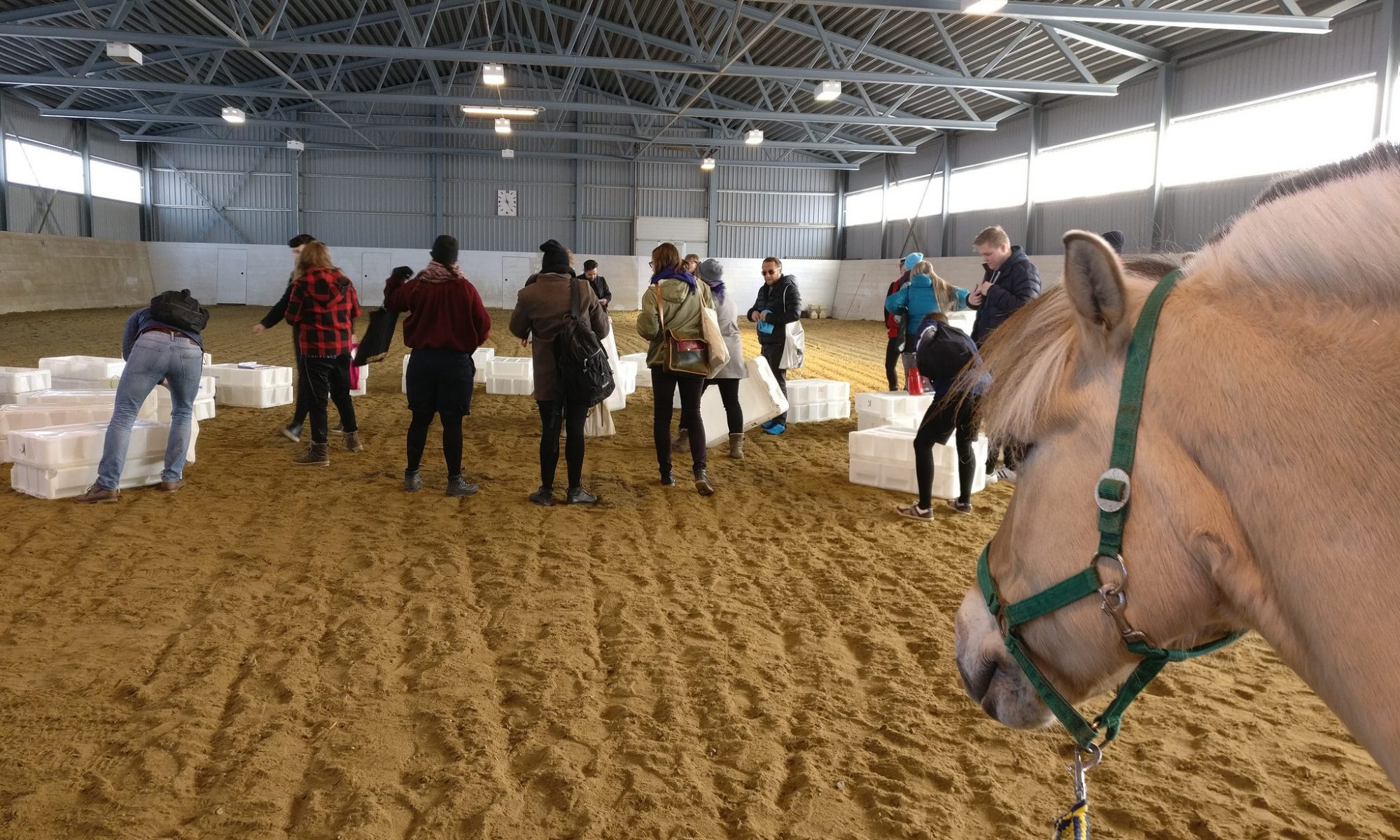
Progressive Infiltration

Ima Iduozee gave an interview for Ruskeat tytöt in 2017 where they recalled an insightful moment that affected their understanding of “integration” in Finnish society as a black Finnish person. The full interview focuses on their artistic practice and does not address integration in detail but I assume the working premise is that in a majority white culture “integration” includes a demand to comply to white gaze – without equal pressure for society to change.

Their interview presents a solution, or an angle towards the question of integration.

Military conscripts are not allowed to wear their own clothes when leaving the barracks for holidays, this is a brilliantly effective tool for the army to enforce its presence in public spaces. Iduozee recalls when they were granted leave and moved through the city in uniform. They describe it as passing in the city: the uniform afforded them public acceptance. They present this as “infiltrating” this society, and propose investigating it in opposition to integration. They propose hacking the system.

Uniforms allow us to take space, to circumvent expectations and biases. The interview presents it as a path to outsmart and topple systems, operating in them without compromising ourselves. I think this offers a novel path for organizing progressive spaces. Movements and assemblies may work against integration, yet occupy structures that afford them to pass in the public sphere. This is useful locally, in a society led by the elderly, that still wants to maintain democratic structures, expressed as a multitude of “independent” organizations such as associations.

A classical precondition of progressive movement hinges on a miraculous-amount of study, self-improvement and sustainable community organizing. (In practice I think sustainability is too often defined as something quantifiable but the focus should be on desire, which we should seek to maintain as we progress upstream) This is a utopia we work to achieve and which I believe in, by committing in sharing skills, knowledge and making thought accessible. The premise of collecting a miraculous-amount of people under an umbrella for the revolutionary phase to emerge, is a monolithic approach. I have a feeling that hacking and infiltration offers relevant momentum for organizing.

Hacking works because it does not rely on our best trades, rather it starts from the premise that systems are made vulnerable because we, as humans, are exploitable. Respecting our weaker trades as organizers, affords fluidity and dexterity. In practice, as an organizer in progressive spaces, I can only hope that people share a trajectory, and even accept that they do not articulate their goals in a manner I feel comfortable with. I don’t want to police people’s desires.  Hacking leans on trust and enforces trust in others. People do not need to engage from a shared premise to be effective in their revolt against ruling class interests.

As an example, all European independence struggles have been started by conspiring to topple ruling groups. To foster change, it makes sense to maintain tolerance for people who are building movements by enforcing binary models (us vs. them). I choose to trust that people will, through inclusive organizing, favor democratic models because the desire to be together is stronger than a desire for control.

This way organizing emerges as something close to community pedagogic’, where the focus is in facilitating people’s engagements and mutual aid, so that we don’t hurt each other. It respects people’s autonomy and embraces weaknesses. The process is led by a desire to ensure that respect for basic human rights is maintained, rather than testing or vetting the rigor of people’s ambitions or militancy. A common understanding of what people want, will emerge as we proceed in toppling the structures that oppress us.

I know scientific Marxism identifies this as opportunism, which is proven to lead to betrayal and… I’m conflicted. But right now, for me it feels that the local terrain permits shrewdness. The sustainability deficit of our local boomer-generation-erected-institutions is heading towards a full collapse. The responsibilities which a multitude of specialized institutions have maintained are being redistributed, or re-concentrated and positions of power are up for grabs. Social services, and some health services like gambling addictions are now handled as volunteer efforts, and safeguarded positions (like volunteer vote-counters in elections) are crying for community involvement for their upkeep.

There are real openings which progressive groups can choose occupy, with small risks and minimal effort. The moment for this occupy movement is now and won’t wait for proper class consciousness to emerge. While we wait, we risk losing access to the public sphere and the popular support of local democracy initiatives.

20180111

On route from Turku to Helsinki the train hit a person. It was a loud sound and the train shook. There was only one impact which faded away accompanied by a series of crackling noises. I first thought it was caused by stones on the track. It’s too dark to see through the windows. The train is now waiting for security officials and paramedics. After they take control of the scene we will be allowed to continue. I can see someone walking a dog outside. When it happened I was looking at the Moog Drummer from Other Mother announcement. The police walked past the isle, accompanied by a conductor. I didn’t talk about the incident with the waiter serving coffee. It took 1h 50min to clean the tracks. People sat still on their seats in silence. When we reached Pasila the conductor apologise for being late and thanked everyone for the trip. The way he thanked sounded honest – He was grateful for the behaviour of the people on the train. It was a death train.

34C3 – Humans as software extensions a good presentation by Sebastian Schmieg. Notes on the presentation below (not actual quotes). He also has a solid video online at http://i-will-say-whatever-you-want-in-front-of-a-pizza.schloss-post.com

People extend computational systems by offering their, bodies, senses and cognition for them. This exchange takes place in the The Stack (as defined by Benjamin Bratton) a computational totality of planetary scale, which includes rare earth minerals, data centers, bots and people. In this computational totality even the smallest nodes (people) can be controlled and programmed. Factory workers were extending machines with their bodies, freelance workers have escaped the factory but they have to offer themselves as flexible extensions of the modern media assembly line. Schmieg argues that precious work conditions enforce “Forced Creativity”.

He believes that artificial intelligence will not replace people but it will be used to organize the labor force of people who are forced to work as software extensions. A concrete example are Google’s image recognition captchas (used to teach machine learning algorithms) which have transformed work into such a short tasks that it is and feels like nothing (This is how post work society should be understood). When you try to pass a “I’m not a robot” captcha you do involuntary work.

Schmieg believes that our position as software extensions grants us the possibility to effect how AI systems (etc.) make sense of the world. By feeding false or ideologically motivated material to the systems we can use them for our benefit. I agree and this is the reason I’ve actively added political vocabulary to the Google Docs spelling tools.

A short text remembering Finland’s Red Women (1918) Kristen R Ghodsee.

A 2016 study by a young historian, Marjo Liukkonen, uncovered evidence revealing that the Whites executed far more women and children in the infamous Hennala concentration camp than previously believed.

Afrosuomen historiaa etsimässä, V jakso: Katse tulevaisuuteen (2017) Ruskeat Tytöt. An episode about afrofuturism featuring an interview with Ima Iduozee. Towards the end the presenters recap how it felt like to make the series. It would be interesting to read a etnofuturisticly influenced afrofuturistic scifi story. A group of Afro-Finns fighting for the survival of Finno-ugric culture using magical Nokia technologies. More on etnofuturism and it’s problematic origins: Etnofuturismi suomalais-ugrilaista
identiteettiä rakentamassa (2005) Anne Hyvärinen.

20170807

Ima Iduozee talks about radical dreaming, afrofuturism and dance on the Ruskeat tytöt blog. He focuses about the experience of alienation and presents social hacking as a tool for integration. The portrayal of hacking as integration is clever.. Perhaps social hacking would offer a more effective framework for developing cohabitation skills in general. Integration policies currently expect people to transform themselves into Finns. The hacking approach would allow them to stay as they are, while making the system work for them. He credits his time in the military as an eye opener: The uniform alienates (from a personal body) and grants access (to a general body). This aspect of the military would be very interesting to explore. Iduozee is hosting courses at Zodiak in the Autumn and I’m tempted to enroll.

But.. I wont have the time. My autumn is going to be very intensive. I’ll be leaving for Brussels in a month, stay there for two weeks and three days after returning perform in NPTurku festival. After Turku I’ll work as a workshop host for youth in Hyvinkää while working edit +20 hours of video material of the Mounted Police force of Helsinki and preparing for a show in Vuosaari with Vili Mustalampi. I’ve reached the point where I’d benefit from an assistant (and even afford to pay them).

Ruskeat tytöt blog has interesting new entries. Afrosuomen historiaa etsimässä (“In search for the history of Afro-Finland”) podcast investigates the history of Finnish colonialism and racism. Maija Baijukya demonstrates how Finnish colonialism begun early 1600. This is evident through figures like Clas Fleming and Hendrik Carloff. Finns were also present in the Belgian Congo starting from 1890 onwards (See Kongon Akseli for details) and in Namibia. The topic is very important but I think shes cutting corners. She makes a striking claims that the Finnish Evangelical Lutheran Mission in Namibian helped to support Nazi eugenic experiments.

20170317

Studying at Zodiak Men’s Contemporary Dance classes has been fun. The movements we’ve practiced serve as brain-puzzles. So far the series we’ve done have not been very complexed or physically intensive. I’m using the opportunity to learn how to teach movement. Both classes have offered tricks for ground work. The official host Andrius Katinas was sick last night and we were taught by Ima Iduozee.

“By losing our notions of universality, transcendence and ultimately the notion of the real we have also lost the ability to change.”. A Star Wars Utopia and the Slow Cancellation of the Future by Zero Books.

Midway through the SOW: Blacksmith edits. Exporting the files too. The entire project will be around 1gb! Found a decent looking tool for adding metadata Kid3 – Audio Tagger.