20161004

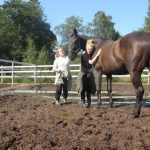
Grey Cube Gallery documentations are completed! Fixed the Italian-to-Finnish translations with Viivi yesterday and send my final invoice to the Union for Rural Culture and Education. My favorite artist presentations was by Päivi Allonen and I also enjoyed taking with the Helsinki Zoo staff. During the summer Honkasalo-Niemi-Virtanen collectives residency documentations were cancelled but I’m overall satisfied with the project.

A lot of interesting ideas concerning the relations of animals and public institutions came up during the Zoo staff interviews but these complex talks didn’t make the final cut. I’ve written some down under the tag “Animals in the City“. The idea that the sites primarily goal is to build awareness of animals as individuals was build up through director Sanna Hellström interview. The Bear Castles that hosted the art exhibitions and events are now left unused and if someone is interested in presenting stuff there they should contact Katri Houtbeckers from the Zoo.

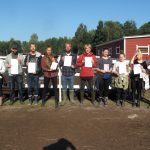
Artist presentations:

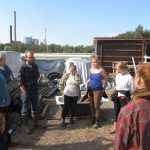
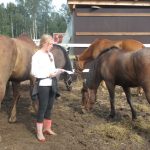
Helsinki Zoo staff and festival documentations:

I’ll meet up with the Union for Rural Culture and Education on the 26th for the “Paikan tuntu” book launch at the movie theater Orion. I was interviewed for the book by Antti Möller.

Visited “Suburbia – Lähiöperformansseja” exhibition by Antti Ahonen and Katri Kainulainen over the weekend. Came too late for Siiri Nevalaises after party piece but got to hear KOELSE drone noises. Many of the exhibition pieces were faux performance documentations and there was a tad too much repetition (Some photos from the exhibition available online). The photos mimicked street fashion looks and presented a hardcore-nostalgic view to the suburbs. Katri and her friend posed semi-nude in rough concrete surroundings. Unfortunately the contemporary fashion industry produces heaps of similar (and even more disturbing) imagery and styles present in the exhibition came off as rip-off’s of Vice magazine covers.

The fashion industry has appropriated the visual cues of performance art! The disturbing documentations such as Carolee Schneemann’s “Interior Scroll” (1975) has been normalized trough Vice magazines commercial interests in the niche and the perv’s. The best way to rebel against these processes is to produce documentations which look boring!

Had an interesting chat concerning photography workflow with Antti. His archive on flickr is packed with performance art, street art etc. event documentations and artworks. The huge cultural heritage collection he has build has been made intuitively. He does not “waste time” with color correction (he’s colorblind) and he trusts the camera’s/computers automatic sensory. This approach alleviates stress and enables him to take on performance documentation gigs rapidly.

Sometimes the winning move is to renouce the fight. #ॐ

20161002

“Manufacturers had begun developing synthetic fibers as early as the 1930s, but much of the production shifted to military purposes during the war. Wartime research accelerated the development of synthetic fibers, which were used for making parachutes, tents, and ropes, and improved the fibers’ quality while driving down costs. When peacetime resumed, manufacturers found that bridal gowns were a uniquely good fit for the burgeoning supply of the materials: the fabrics were far less expensive and easier to deal with than satin and silk, making the dresses more widely available.”

Victoria Finkle details in “Why Do Brides Wear White?” article.

20160929

Finished my article “New Material Intercource” regarding contemporary sex-toys and their impact on the environment and our sexual expression. It’s currently being edited by Tuomas Laitinen and it’ll likely come out before Christmas in the Esitys-magazines Masturbation-edition. I draw nifty pictures to accompany the text. The illustrations are available on Openclipart: New Material Intercourse – Clipart collection and they are licensed for unlimited commercial use! The text echoes the “handicraft-ethical / future archeological” thinking we’ve developed over the years through various Ore.e Refineries activities. One slogan we’ve deployed with Jesse was: “The future is decided with hands” and the “New Material Intercource” text takes this statement literally.

Watched and appreciated “November” (2004) by Hito Steyerl. The movie convinced me that narratives are a thing of the past. At time artist were trained to produce counter-narratives in an effort to voice out opinions of the oppressed. I’ve now come to understand that the problem is with narrativity itself. Every narrative ground events in to mythological continuum.

Every story, tells the story that there is a founding myth. #ॐ

Met with Päivi Raivio and I agreed to join her “Rescue Museum” events in November. I’ll possibly be working to salvage personal digital heritages of unknown Facebook users.

Met with Pilvi Porkola and went through my participation in her upcoming show for New Performance Turku. I’ll be using a kettlebell and making techno on stage with her.

20160928

Visited “The Museum of Nonhumanity” by Terike Haapoja & Laura Gustafsson and crew. The exhibition was translated in Finnish as “Epäinhimillisuuden museo”. The naming of their work was confusing as the piece was not concerned about non-human agencies. The stylish (meta-ironic) installation displayed technologies and cultural practices which are used divide, categorized and control human populations, sites and other organisms. “The Museum of Nonhumanity” showed a carefully selected series of historical events during which people have dehumanized and treated as animals in order to justify their control and slaughter. Texts and documents which were presented in the installation focused on statements and quotes made by warmongers and capitalist which presented the groups of people they wanted to control (or kill) as animals. These snippets of information were presented as evidence that our relations to animals are aligned with our relations to Others.

A gruesome part of the museum revealed that wild wolves and female soldiers of the Red Guards were discussed as pests. Apparently a lot of female soldiers of the Red Guards were killed during our Civil War in 1918. Their systematic slaughter was organized by the White Guard officials and they justified these monstrosities trough eugenics and saw it as a form of pest control!

Guests were handed catalogues which featured a nifty text by Giovanna Esposito Yussif which bashed museums as sites which use collections to justify the status quo of the regimes that fund them (The text didn’t discuss the fact that the same dynamics are evident in the majority of art that is made. Also museums are no longer dependent on their collections. They have converted in “event sites” which serve the public in a very similar fashion as the “The Museum of Nonhumanity”). The second text in the catalogue was by Salla Tuomivaara. She pleaded for empathy in human-human and animal-human relations. Unfortunately the artwork and the texts didn’t discuss the agencies of the animals or the human victims. There was no trace of their resistance and constant efforts to re-negotiate their treatment. Unfortunate animals and humans were presented as mere resources for colonial ambitions. The intent of the show was not to build awareness about the agency of animals – It presented a collection of methods and tools humans have used to instrumentalize their fellow beings. 

20160923

A more detailed reading of Angel Archer’s article “Botline bling” opened a new trail of thought concerning the anthropocene and post- / trans-humanistic sexuality. Dorothy Howard looks at sex, hyperreality and the politics of intimacy in “Loving machines: A de-anthropocentric view of intimacy“. The writer also investigates the deep emotional relations we form with technologies (We sleep with our screens). Paul B. Preciado’s “Contrasexual Manifesto (Excerpt)” explores sexuality and gender as capitalistic tools aimed for exploitation of the others (If I understand it correctly). “Queer Atonality” by Alexander R. Galloway seeks to build awareness on how the usage of queer terminology and methodologies is being appropriated by various (normative) academic disciplines and used in political rhetorics. He approaches the theme through an analysis of “The Molecularization of Sexuality: On Some Primitivisms of the Present” article written by Jordana Rosenberg.

Rosenbergs article is pretty complicated. It is critical towards Object Oriented Ontologies as “object-ontologies are origin narratives not just because they are compelled to project forms of ‘ancestralness’, but more specifically, because they exchange frictionlessly between two sets of seemingly opposed orientations – origins and prognostication. Object ontologies, in other words, cast a twin temporal shadow: the ancestral and the futural. Or, the primitive and the brink.” The author continues: “[…] the ontological turn reiterates a version of this settler rationality, borrowing – or, rather, capsizing – a set of arguments from queer studies in order to grasp biology as a kind of sheer queerness (or, aleatoriness) that enshrines a primitive/brink temporal logic while appearing nonnormative and in some fundamental way resistant to the demands of capitalism’s logics of time, discipline, and subject-formation.”