
We were fortunate to organize the fourth Horse & Performance course for the Theater Academy in the fall of 2020. Together with Pietari, we experienced challenges teaching art during a pandemic face but in the end things sorted out well. At the time COVID spread in Finland was at a decline and the University of Arts Helsinki deemed the course possible. The horse-hobby and equestrian industry here seems well equipped for dealing with the pandemic. Riding group sizes seldom exceed 10 members (and horses) and activities are organized in sparsely spaced sites, which deems it a safe activity. In fact horseback riding is a booming hobby, it offers a much needed outdoor experience and companionship. We were kindly welcomed to Malminkartano by Kaarelan ratsutalli Oy. Kaarela was a well suited site for organizing the course, it is easy to access with public transport and the area has an interesting history.
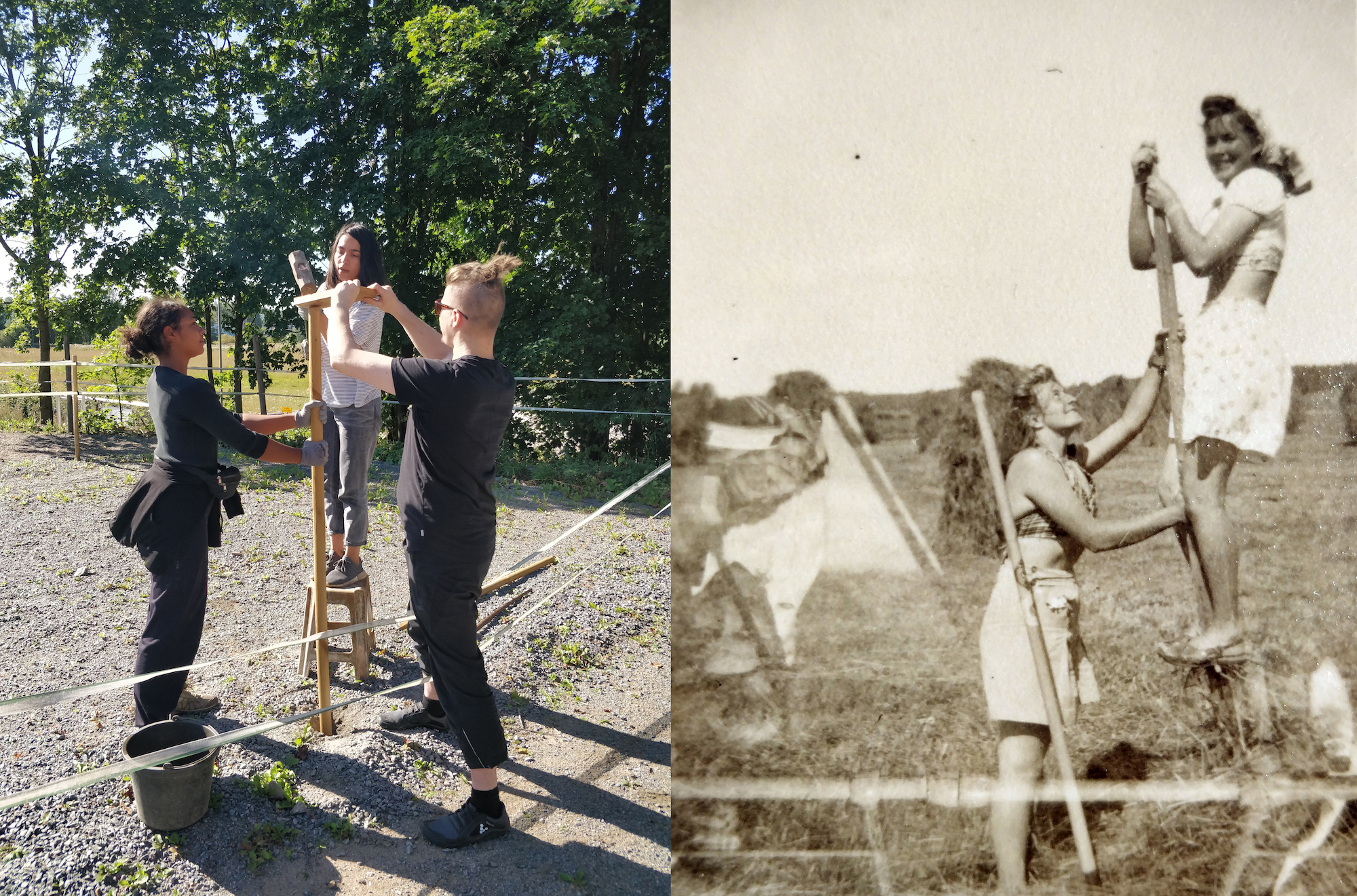
Horse & Performance had seven participants: Antonia Atarah, Anna Lehtonen, Daniela Pascual, Martta Jylhä, Gaspare Fransson, Mikael Karkkonen and Jouni Tapio. On previous courses most of the participants have been from the acting department but this time around attendees formed a balanced mixture of dramaturgist, actors, live-artists, pedagogist and sound/light designers. In 2017 we started to collect course notes to collective study journals which participants can access online. The journals present open ended questions which the course stirs up, links to texts people refer to and discussions on the exercise we partake in. This time around the document is semi-public and can be accessed as a .pdf document. We didn’t offer the same volume of practical horse handling exercises as before. Instead we focused on working with the animals at their pasture and got to engage in an array of stable chores. Participants build a hay-shelter, erected fences and collect a lot of droppings from the pasture. I think the course was ultimately about maintenance art and laced with a crafty approach to non-human knowledge.

Taru Svahn who had established the stables twenty years ago gave a thorough introduction to the site. We learned that there has been horse related activity in the area at least since the 18th century and that the site had been a farm until the 60ties. She presented us documents from -62 which detailed farming experiments Helsinki University conducted on site and provided a history of the Malminkartano mansion from 1579 onward. Svahn told us that her motivation for establishing the riding school was set in motion by a dream which presented her a galloping horse. The dream led her to equestrian studies in Ypäjä and eventually to start a business in Malminkartano. Quite recently they have managed to expand the stable by building a manège which enables them to organize courses comfortably during the winter. When we started with horseback riding with Pietari in 2014 the manège was yet to be build and the outdoor classes in Malminkartano were really cold.
As expected working with city officials for permits to build a horse stable to a suburb was an enormous effort. Rights were eventually granted based on the site’s historical value and history with horses. In short: The horses of the past, paved way for the horses of the future. There are archaeological sites (röykkiöhauta) close by and the nearby forest is protected from development (Malminkartano was an island until 3000BCE). Svahn explained that ultimately the permission process was paved by personal relations she formed with individual city officials and a lucky coincidence where the right mix of city committee representatives happened to be in the same room at the same time. It is revealing that charisma and luck are central for city development. Svahn’s motivation for establishing the site was to grant access to horses to the youth of the district. The suburb was troubled in the 90ties. Still is.
Each day started with a morning meeting at a forest opening. Pietari heated water with a portable stove, we all sat on a branch and chatted while having coffee. The morning sessions worked well for establishing a casual relationship to the texts and theory which we structured the teaching on. There were lectures in the forest too. I fondly remember Pietari’s introduction to speciesism, with yellow rays of sunlight reflecting from the moss. When preparing for the course we were inspired by the Gustafsson&Haapoja: Museum of Becoming HAM exhibition and picked up texts by Cary Wolfe and Terike Haapoja from it. The main culprit for the theory of human-horse-relations was yet again Haraway and we turned to Soppelsa for developing insights to the role horses have had for the development of modern Europe.
At the end of the two week long course participants were invited to develop group exercise or artistic outputs, which reflected their evolving relationship to horses. This lead us to organized a miniature horse-art festival of sorts. It offered dance pieces (witnessing a horse-human dance led me to understand the relationship as a highly choreographed communication), audio-based-works (which presented arbitrary horse movements as dance), meditation and body awareness sessions (we could imagine ourselves as plants and experience ourselves as a self organizing assembly). Summaries and group reflections on the exercises are documented in the collective study journal. One of the most memorable experiences I had was a session titled “Horse’s Birthday” (Jylhä & Karkkonen). The session started with us setting a picnic table in the middle of the pasture. As we started to eat cake and to perform a birthday ceremony, our gathering and the sweet smells lured the horses in and soon our assembly was rearranged by a herd of animals. They revealed their ultimate power-move: Breaking crowds with their hulls and caused disarray in organization. Our picnic was efficiently disbanded and we were caught between rivaling horses.
Previously, in teaching art I’ve emphasized the act of “stopping” and we often practice it as a part of physical exercises: I encourage students to be rude, to halt the charismatic flow for making notes, formulate opinions and set new plans in motion. During the pasture-birthday session I noticed that I have not developed artistic exit strategies which would afford sensible and secure retrievals from difficult situations. Most horse-human exercises I’ve participated in have been focused on becoming with the animal and after the exercises have peaked we look for an opening where we can depart peacefully. This works great for establishing a sense of security but requires that the horse-human session is carefully planned: I’ve witnessed numerously how facilitators work towards soft departures. Working in the pasture –which is the horse’s domain– requires that people would also be equipped with skills in distancing themselves from the horse at haste. I think I should develop artistic skills to escape a bad situation (like a rodeo clown). I was petrified during the performance. We got stuck between five horses, a table and the cake we brought with us. I didn’t know how to safely distance our group from the dominant maneuvers of the horse herd.

On the last day of the course we got a tour of the Ruskeasuo Police horse facilities. Senior Constable Jukka Aarnisalo took us in and offered a glimpse to the offices of the 130 year old police unit. We were invited to their very compact kitchen and debriefing room, which is located in a corner of the Ruskeasuo horse stables. Inside we were presented with old Russian era swords (brought from their old headquarters in Kasarminkatu), WWII memorabilia and trophies from past competitions. Their current stables were built for the Helsinki Olympics and manifest the functionalist architecture movement in its prime. Modernist traits can be identified in the facilities waste disposal arrangements and the usage of natural light, which early modernist architects associated with hygiene (as defined by Kirsi Saarikangas).
Our visit to the stables ended the course to a very conflicted setting. Participants had just spent two weeks (re)sensitizing themselves to the nuances of horse-human communication, after which we were confronted by a professional with over 30 years of experience in working with animals in urban settings and effectively teaching multiple generations of horses skills for desensitizing themselves. To add to the confusion the skills in question were taught in a respectful working relationship, in institutionally monitored and publicly scrutinized setting. All done just so that the police-horse and the police-human could enforce the law effectively. It safe to argue that mounted officers (and their horses) are the most visible public servants and most criticized law enforcers. I personally enjoyed the conflict because the sensitive and emotional sessions we shared with horses in Malminkartano, were balanced by the reality and lived experience of people working with animals and animals working with people.
Horse-pedagogical efforts will continue in the spring as well organize a course called Horse & Build Environment for Aalto University. On this course we will explore horse stable designs and the relations they afford us.

