20181023

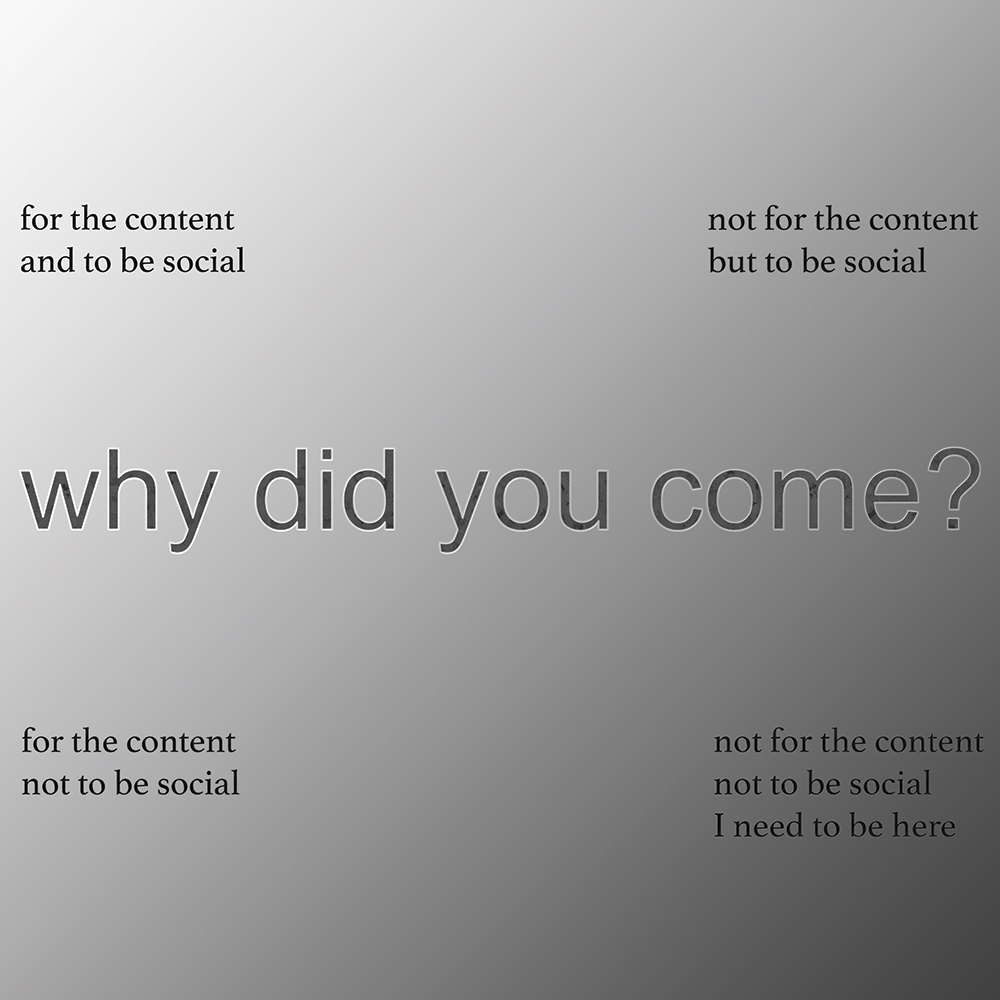
Put a pretty plate in a big box. Place the box in the center of the room. Set a hammer on the box. Participants have the obligation to break the plate but they have to break it secretly, so that nobody will know who is responsible. The box is checked periodically (by the entire group). The exercise continues for as long as the plate is intact. When it is discovered that the plate is broken participants use a ouija board to consult each other who broke the plate. #ॐ

20181019

WWC: Carlos Colón vs. Hercules Ayala (1987). Frenchie from Frenchie’s Gym serves as the referee in the match. Interestingly after the match the winners family gets on stage to celebrate with him.

Visited ecoartspace: Mary Mattingly and Jean Shin interviewed by Amy Lipton event at the 8th Floor on Wednesday. It was fun to learn about Lipton’s career as a curator specialising in ecologically steered arts. We didn’t get deep into her work or investigate it conceptually. Audiences were presented with a list of her most celebrated projects and exhibitions. Learning about Mattingly’s “public floating food forest” Swale was cool too. I’m pessimistic… I fear these kinds of initiatives fail in making the impact they seek. Not-doing would be more eco-friendly. But I don’t know how to “not do” in a sustainable way. No-Chair-Design campaign is the closest I’ve gotten.

20181016

Sonic Etiquette: Domestication of Acoustic Neighbourhood Relations in Istanbul (2018) Meri Kytö. A sonic ethnography of a middle-class housing cooperative. I get a strong sense of site from this text. It has a nice introduction to concepts such as “acoustic orderliness” (the “endless task on empirical research” trough which people try to fit their habitat acoustically), “spatial segregation” (Kytö argues that “acoustic orderliness” is key in maintaining the segregation of particular groups) and “strategic intimacy” (“a tool with which we can cover, process and utilize status and class distinctions in everyday encounters”).

My interest in the interface between private and communal sonic space is connected to the idea that the domestic sonic spaces of homes in densely built areas of big cities such as Istanbul are intertwined and overlapping. The acoustic space in apartments is porous and flowing: both the city as a public sonic space and neighbours’ private lives penetrate the home, regardless of the walls. “Private” is not a separate part of culture but an area of life that is strongly dependent on values and the concept of the individual. As a historical concept, privacy has been strongly linked to the formation of the Western bourgeois nuclear family civic society. Privacy can also mean information management and hence an individual’s right to self-determination, the formation of an autonomous and considerate citizen as a precondition for a democratic social order.

Taiteen metsittymisestä – Harjoitteita jälkifossiilisiin oloihin” [On the becoming-a-forest of Art – Exercises for postfossil conditions] (2018) ed. Henna Laininen. A book with texts from Saara Hannula, Markus Tuormaa, Isla Peura, Timo P. Vartiainen and Henna Laininen. I’ve only read the “Esitys metsän rajalla” [Performance on the edge of the forest] by Hannula. It’s good, she’s investigating how the forest is performed (in an example she deep-reads the visitor guide of the Paljakka Strict Nature Reserve). Hannula points to Contingency and Complicity (2011?) an essay by Reza Negarestani, to argue that artistic processes which boast their openesess and promote un-authoritarianism, are often dependent on the artist ego, infrastructure and conventions, which sorts out unwanted audience behaviour and risks. Instead of fake-openness – Artists should turn to complicity and closure.

The Crisis of Intimacy in the Age of Digital Connectivity (2018) Stephen Marche. A well written essay on internet’s effect on intimacy. Apparently Bill Clinton introduced the phrase “I feel your pain” in the ’90s. The author believes that people are returning to a believe that words have magical effects – Which is why political correctness is over exemplified, while empathy is diminishing.

The incipient political catastrophe in the United States can be summed up in a phrase: nobody believes the other’s pain is real. Nobody believes the other’s pain is meaningful; nobody recognizes anybody else’s pain. It is the central problem of internet-provoked outrage and loathing, the hyper-partisanship that turns on so many hinges. Nobody is willing to accept the other’s description of their feelings.


20181011

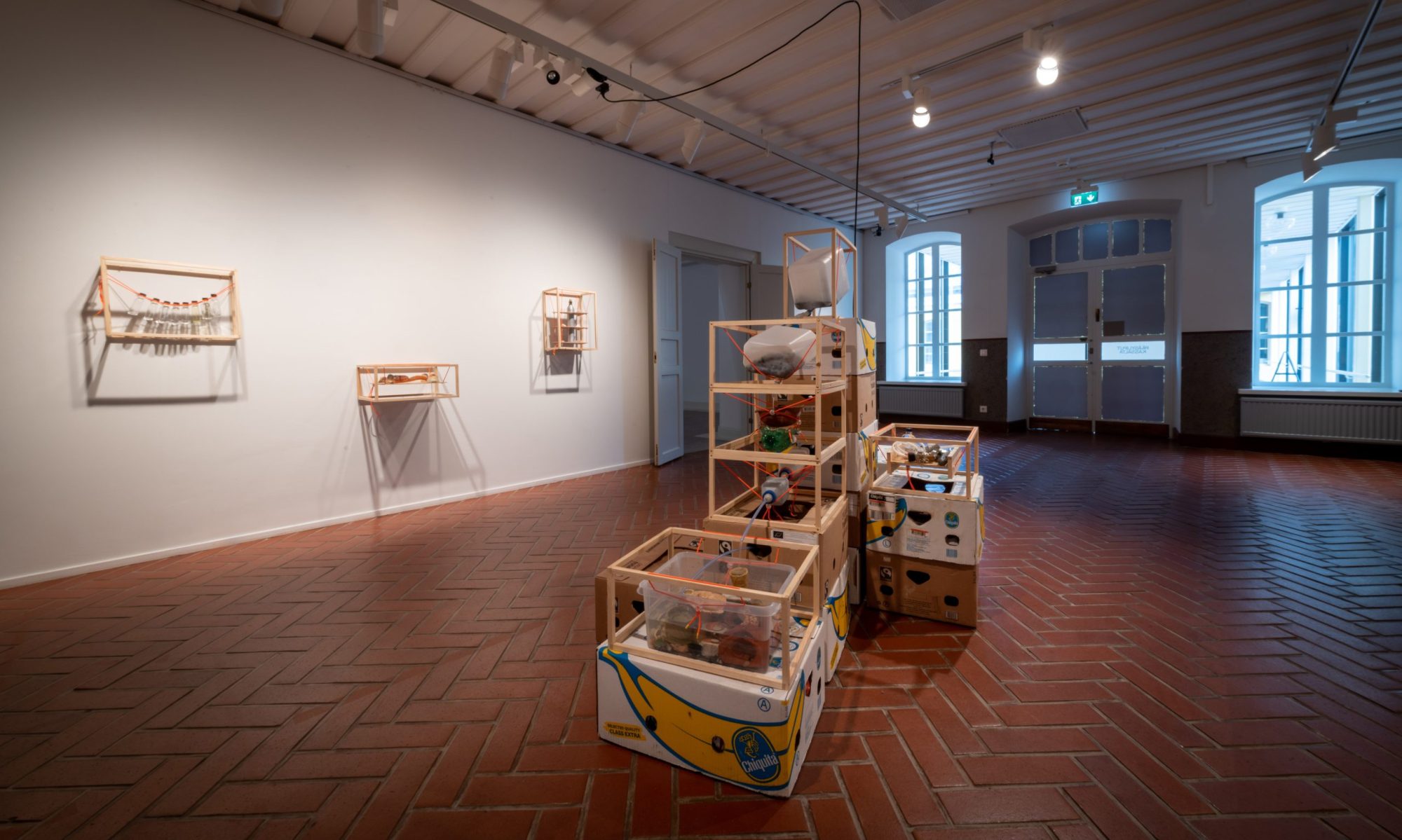
Heard a good gig on Tuesday. Heather Frasch & Koen Nutters performed at a Pennies from Heaven #7 event organized by Control & Bánh Mì Verlag. Frasch used surface transducers to resonate glass & copper jars and a plywood sheet. She then suspended small objects, pinecones, dry fruit shells and pencils above the resonating surfaces. Objects hitting against metal surfaces produced  nanoscopic, near silent melodies and objects resonating on the plywood sheet produced barely auditive rhythms. She produced some very intensive techno beats and I felt a new paradigm opening for sonic exploration (we have planned something similar with Johannes and now I can set my bearings). Towards the end of the gig she placed objects that didn’t make any sound on the surface transducers and we could see them vibrate in silence. Nutters complemented the object-sound-play by playing sinetones and reading two text about how the process of hearing is physically intimate.

Found a nice project Midi thru box 1X5 and Robot voice (posted by dnny from koelse.org).

Got a got a fistbump at Frencie’s Gym after performing a reasonable squat series. Found a few videos of the place.

  • Frenchie’s Gym – Person(s) of Interest (2017) Pablo Bujosa Rodríguez (Most recent footage from the site)
  • FRENCHIE (2013) thismustbetheplace (A goodvibes street-aesthetic mini-documentary)
  • FRENCHIES GYM II (2008)Trevor Bayack (A touching short introduction to the site and a call to fight “corporate gyms”)
  • FRENCHIES GYM (2007) Trevor Bayack (Regarding gentrification and  short notes on technology)

20181008

Learning about the problematic relationship that land-art has with the cultures of the indigenous peoples of America.

The Face of the Earth (2015) by Stefany Anne Goldberg. The text states that Robert Smithson was directly inspired by the Serpent Mound and that he used it as a model for Spiral Jetty. Goldberg points to Entropy And The New Monuments (1966) to argue that Smithson wanted to produce “anti-monuments” that merged with their environment over time – Goldberg states he wanted to criticize the idea of an everlasting modernism (best exemplified in American architecture). I don’t buy this. Authors like Naomi Stead have shown that architects such as Albert Speer were particularly interested in imagining their designs as ruins. (Here are notes from an article by Stead).

Architects, Smithson once said in an interview, tend to be idealists. They look at their structures and think about how they will cover over the earth. They try not to picture their buildings fallen into ruin, sucked back into the landscape they once sat upon. American builders are especially idealistic because the land they were given to build on since the beginning has been thought of as empty space. […] “America,” said Smithson, “doesn’t have that kind of historical background of debris,” and so Americans don’t often think of monuments the way Europeans do, as potential ruins, subject to entropy, subject to change, involved in the story of Time. Time, for Americans, goes mostly in a straight line, from Point A to Point B, with all things getting bigger and better, even when they collapse. For Smithson, time was like a spiral dissolving in salt, neither static nor cyclical but just moving, just going, disappearing and coming back again.

The last quote from Smitson is from the Entropy Made Visible (1973) interview with Alison Sky. It shows a blatant disregard of the cultures of the indigenous peoples of America. Nancy Holt’s Up and Under (1998) looks like it has been inspired by the Great Serpent Mound and the Mound City in Chillicothe.

Rising Into Ruin (2017) Kate Morris. The article investigates the “Post-modern landscape” by comparing Smithson notes on ruins, to artworks by American artist Alan Michelson. Morris argues that Smithson saw ruins as static “end states” and points out that many indigenous cultures of Americas have an opposing cyclic view of time. The text offers a good overview on what Smitson was after with The Monuments of Passaic (1967) text/actions.

[…] I argue that the works of Smithson and Michelson differ in important ways that are reflective of their cultural perspectives: namely, Smithson regarded ruin as an end state, while Michelson posits it as a condition that portends other states to follow. The argument hinges on the distinction of ruin as a stage in a cycle rather than as a point in a purely linear progression.

A postmodern condition that [Craig] Owens failed to locate in Smithson’s work is an attack on the idea of progress itself, though it seems clear in retrospect that Smithson’s careful documentation of the decline of industrial infrastructures was exactly that. Moreover, it is this aspect of Smithson’s practice that resonates strongly in Michelson’s work, where the notion of progress is conflated with settler colonialism, and thus its dissolution can be regarded as not only a postmodern but distinctly postcolonial condition.

Entropy tells us that nothing can stay in suspension forever; dissolution is inevitable. In “The Monuments of Passaic” Smithson’s entropic vision may come across as temporally muddled, but phrases like “rising into ruin,” “limited eternity,” and “a lower stage of futurity” obfuscate what is actually a rather linear progression.

Sympathetic as he is to Smithson’s dystopic vision, Michelson has also been drawn, paradoxically, to the latent hopefulness of “entropy made visible.” In both Mespat and Shattemuc he focuses on the crumbling infrastructure of industrialization, and by association, of colonialism itself.

The Spiritual Legacy of the Ancient Ones (1992) Robert Houle. A text from the catalogue for Land, Spirit, Power exhibition organized at The National Gallery of Canada, Ottawa (almost 30 years ago!). Here is a very detailed review of the exhibition by Scott Watson. I was encouraged to study this exhibition by Richard William Hill and Jolene Rickard (Tuscarora), whom I was kindly introduced to at the Vera List Center Forum 2018: If Art Is Politics event. The text attempts to build a framework for reading the art of the indigenous peoples of Americas, in a way which would not rely on a colonial gaze for making forcing sense a particular-western-defined-sense.

Houle’s text is critical towards post-structuralism and postmodernity because it disregards non-western modes of existence. In short: Not all origin stories are bad, not all narratives should be deconstructed and the critique that post-structuralism engages in does not challenge the infrastructure that enables it. It is a smokescreen! Modernity is in dept to indigenous cultures – Artist such as Pollock and Picasso formulated their encounters with indigenous artworks into techniques.

The text also has a detailed history of how the indigenous peoples of Americas have been portrayed in Euro-Western art. It provides a critique of Monument for the Native People of Ontario (1984–85) artwork by Lothar Baumgarten. More on that particular artwork and Houle’s commentary on it in Naming and Reclaiming (2018) Shirley Madill.

The article is filled with interesting details. For example: “There is no word for ‘landscape’ in any of the languages of the ancient ones still spoken” and ” [I]ndividuality operates in the language of paradox, irony, and ambivalence”. The text ends in a beautiful invite: “[T]he spiritual legacy of art from any one culture offers reassurance that the human species has some commonalities which are important to knowing who we are, where we are, and where we are going”. Quotes from Houle’s text below.

Continue reading “20181008”