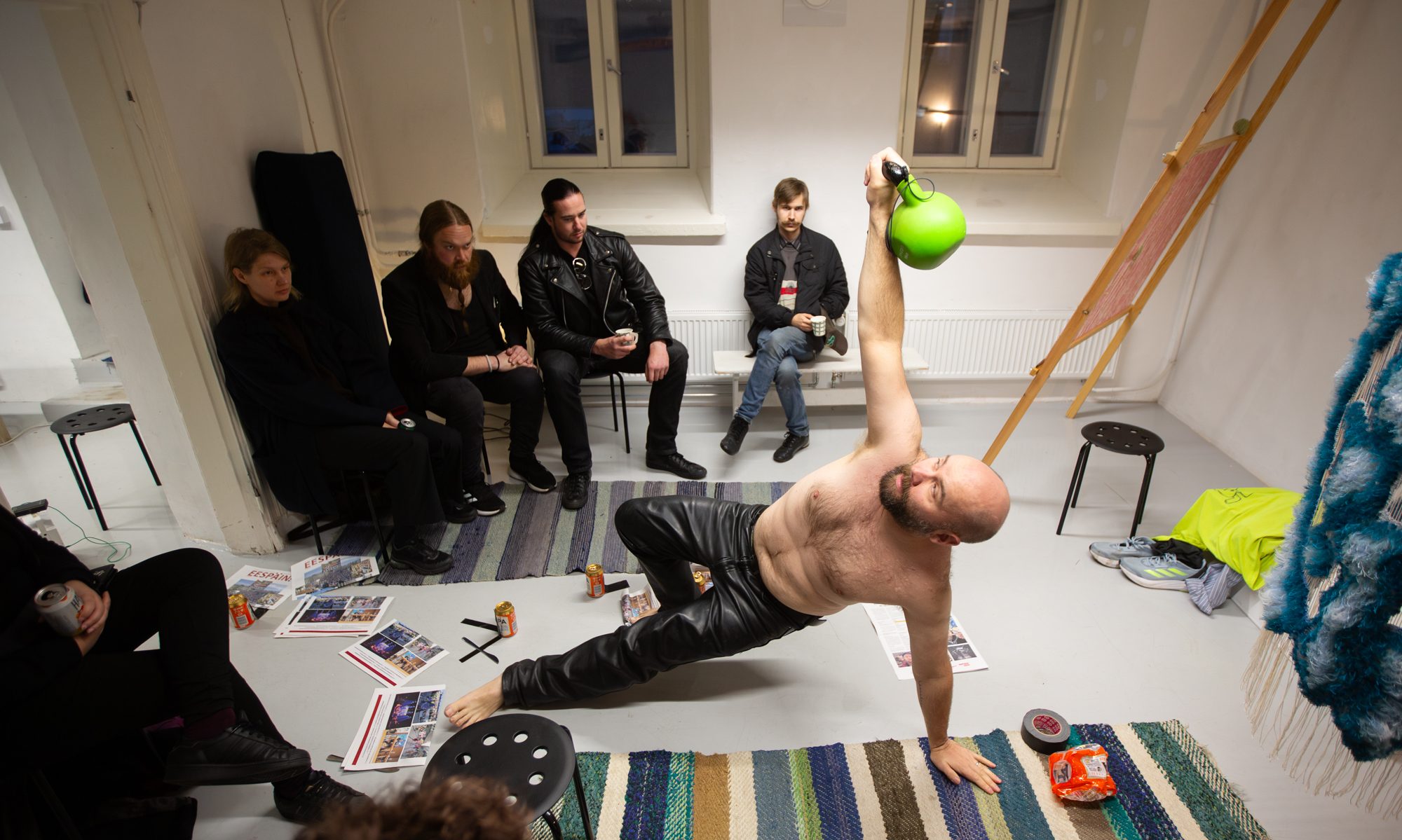
Call for Action: Key Moments in Estonian Performance seminar at Kiasma by Anu Allas (Kumu) and Maria Arusoo (Center for Cont. Art Estonia) was a tad unbalanced. The presentation felt like a marketing event and suffered from technical difficulties.
Allas opened the event by explaining that Estonia was “The West of the Soviet Union” and that artists generally enjoyed the protection of the state and their experimentations (influenced by John Cage and the Fluxus-movement) were condoned and encouraged. She presented Pirita beach as an important venue and explained how the artists of the 70ies were influenced by Western art: “They just heard what artists in the West had done and tried to do something similar”.
The humorous nature of early performance art was underlined but unfortunately the political nature of this humourness was not identified as a method for organizing soviet underground art (Crusaders’ School of Pure Humour Without Joke in Prague is one example, Natalia Lach-Lachowicz from Poland an other). Allas claimed that there was no underground arts in Estonia. She mentioned artists Jüri Okas (Water Man, 1971), Siim-Tanel Annus and Raoul Kurvitz. The last two were presented as key figures of the post-soviet performance scene: “The Western art world expected that after the collapse of the soviet union these kinds of physical artist, manifesting raw creativity would emerge. They thought that this kind of expression had been suppressed by the soviet regime and wanted to witness it being liberated”.
Jaan Toomik (my guru from 2007) was mentioned as a god-father figure of Estonian contemporary art. He was framed as an “export artist”, a male hero of his time. We saw extracts from “Dancing Home” (1995) and “Dancing with Dad” (2003). I like both works (A lot of Estonian classic performance art can be found online). His work was presented as “responsive”, in comparison to feminist artist of today whos practice was presented as “reflective”. Valie Export Society was referred to but unfortunately the presentation didn’t cover their work in detail.
It occurred to me that “location sensitive art” made in post-soviet / peripheral-west countries is a perverse form of nationalism. Artist utilize western proven styles to exhibit their personal freedoms (which is often framed as creative violence against status quo). In this process their audiences can identify how these styles differ from the local culture and values and feel different (from the west) but the same (as the westerners). Post-soviet artists are celebrate for their creative independence but their value is judged based on how they received by western audiences.
Note: “Location sensitive art” came about as a concept in a discussion with Kristian. He told me about his trip to Ahmedabad and explained that locals navigate the city (and their lives) following a contextual map. Their caste, profession and religious prophecies determine what is possible for them, where, how and at what time of the day they can move. Kristian explained that westerners are “not location sensitive”, they believe that they have the responsibility to test the world.
The rest of the presentation was off balanced. Arusoo referred to Ene-Liis Semper, Flo Kasearu, Kris Lamsalu and Maria Metsalu but their work were presented in a form of a sales pitch: “She has refused to perform this work many times […] you at Kiasma are very lucky to have her here…” etc.
The history of Estonian performance art came off as a narrative on how a fringe ex-soviet society became an incubator for generic western aesthetics and styles: “Now we are equal to every other european country, many artists who work locally feel left out.. This is why there is now interest to developing collaborations with other ex-soviet countries”. Non Grata was not mentioned (as a member of the Estonian performance art family) and for some reason events between 1970-1990 were not discussed.