[En] How to Craft Portfolios: Visiting Muu Ry

Thanks to a tip from Jyrki Kirjalainen I got the opportunity host a course at the Finnish Academy of Fine Art. It’s been a while since I’ve done any teaching.. And this is the first time I’m runnig a intensive course on how to make portfolios. I’ve previously hosted only performance art courses. A friend who has worked alot as a teacher told me that instructing technical things (like how to use desktop publishing software) is more relaxing then teaching others how to make art. But I’m not sure… I’ve collected all sorts of online tutorials, images etc. online and additional material will be published during the week.

I hope this material will be of use for others in the same situation and if  you have some ideas on how to improve the plans, you can write suggestions and changes straight in the text. Below is a memo from a field tript to the Muu Ry Association portfolio library.

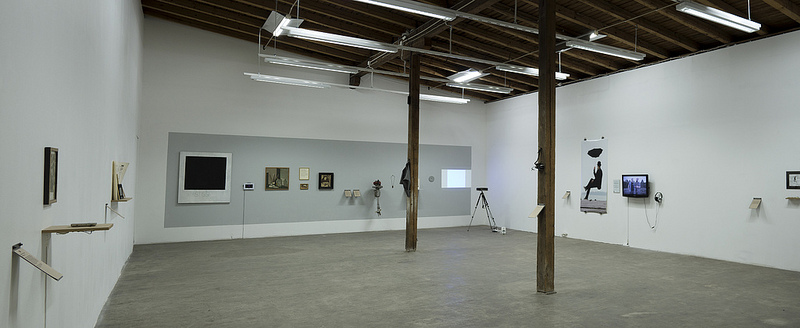
Artist Timo Bredenberg arrived for the voluntary Valentines Day date at Muu Gallery. He’s not attending the course so it was fortunate that he came. We browsed trough the Muu Ry portfolio library together. The library is open for all visitors and if you want to have a general view on how artist present their work in printed from I recommend you make a visit there. No appointment is required and Muu Association staff will answer any questions that you might have.

When artist apply for membership in Muu Ry they submit their portfolios for evaluation. If they are accepted the portfolios are added to the library. Members are encouraged to update them over time.. But unfortunately artist seldom find the time to do this. The library was cleaned a couple of years back and some really old un-maintained portfolios where tucked away. Even so most of the portfolios there today have not been updated for a few years. So you wont gain insight to the current Finnish art-life there.. Luckily most of the members have web-porfolios (http://www.muu.fi/site/?page_id=18) and some even update them!

Some Muu members are famous today and their portfolios in the library have been neglected for ages. It was interesting to read trough old artist statements and see how people wrote about their work 10 years back.. It was like reading old diaries. The way art is talked about changes really fast and even two year old texts felt outdated. Many portfolios had been made with laser printers and trough time their colours had darkened.. In worst cases it was hard to make out what the pictures where about. I grew weary of the plastic-folders most artists use to present their portfolios in. The quality of the plastic is crappy and the “transparent pocked-pages” made even decent ink-prints look cheap.

It’s bad for everyone if the majority of portfolios remain neglected.. After investigating ten abandoned portfolios in detail I sort of lost faith in the hole affair. If you are not planning on updating your portfolio at the Muu library.. You should reconsider if you really need to store it in there. Some members had already replaced their portfolios with exhibition catalogues and other publications. Printed catalogues where more interesting to read trough.

There where some pleasant surprises among the portfolios. I particularly liked Lauri Wuolios presentation. It was a sort a box that had several high quality a4 prints, some exhibition flyers and a CD (if I remember it right) in it. Like a treasure chest. Each printed page featured one work. There wasn’t a player nearby so I could not access the data on the disk.. The prints weren’t attached to each other and the contents could spread on a table to gain a fast general view on his art. (Wuolio told me later that he had made this kind of portfolio so that interested parties could take photocopies of the pages conveniently!!)

I also liked the portfolio of Katri Kainulainen (even though it was really old). An interesting feature of it was that she had two separate CVs in it. One for her personal artistic work and an other for a performance group called “RUBENS” she’s member of. The idea of having a fully separate CV for separate projects seems smart. The majority of the portfolios where made in standard A4 size and had upright layouts but atleast Arttu Merimaa and Miina Hujala both had horizontal portfolios. I think that many painters and photographers would benefit from this approach because there is more room for images. Anyway I hope that participants of this course will find the time to visit the gallery.

=== EXTRA (In Finnish) ===
Täyttikö yksikään portfolio näitä kriteerejä? Ei
Kirsi Niemistö-Smedberg: “Galleristin näkökulma kuvataiteilijan portfolioon”: http://www.slideshare.net/Koistinen/kirsi-niemist-smedberg-portfolio (Vanhaa ja värittynyttä tietoa mutta kiva lukea.)

[En] Review: ⌀20cm Praxinoscope by Hemisferium

Featured Video Play Icon

I got the opportunity to play with early cinema technology targeted for the victorian age markets. The contraption is called a Praxinoscope. Our device was bought online. It’s made to look as it’s old in hopes of appealing to vintage-fans. But the frame is plastic. The device was build in Spain by a company called Hemisferium.

Outi Heiskanen has contracted me to assist in the construction of “primitive moving image technologies”. We bought this device as we couldn’t find any decent tutorials on how to build one ourselves. It’ll be pimped (or we’ll build a new device based on the model) if this technology will be used in her art exhibitions etc. A couple of years back we started working on “Tibetan Candle Turbine” technologies and since this I’ve experimented with a variety of low-tech image projection techniques. A highlight of which was the discovery of parabolic mirror projections (which Paula L. now owns).

For the praxinoscope tests we compressed the “Starswing” animation we made with Outi into 12 frames. The outer rim of the Hemisferium praxinoscope is ⌀20cm so the animation stripes which it uses need to be ~61cm long. This is nice as a 12 frame animation may be fitted on a A4 paper. A A4 print can compress 1sek of animation!! If the prints are made in 300dpi then it could be called a HD moving image screen. The bit rate is high. The printed strips need to be cut from the sheet and glued together.

The quality of the Hemisferium praxinoscope mirrors is shitty. They are made from plastic which add to bad luminosity. The “mirrors” are bend and distort the images too. They are tinted brown to add vintage appeal which is annoying. The device came pre-assembled and there are a lot of problems.. The axis is tilted.. The frame is wiggly. It’s a shitty piece of equipment but it works for testing. There are no labels on the device and it cannot be disassembled without braking the frame. So I made a simple 3d model of the device which can be used to check the measurements incase you want to build one your self. Here are some measurements:

Diameter of outer-rim 205mm. Inner-rim ~100mm.
12 x Mirrors ~28mmX70mm.
The animation sheet is 610mm long and 45mm high.
12 images have 50mm of distance from each other.
Now that we have tested the system we’ll make better prints of the animation (ink was low) and possibly build a more advanced praxinoscope with real mirros etc. Let’s make GIF animations tangible!