A teaser from an upcoming book Radius: A Story of Feminist Revolution (2022) Yasmin El-Rifae detailing Cairo’s Tahrir Square events from ten years ago. The story follows activists working in the Opantish network.
Then I came back on the 30th and went straight from the airport to Opantish. And as soon as I saw the streets, I knew. I knew that we (the revolution) had lost.
Wickedest Sound (2022) 99% invisible. A good vibe podcast offering a DJ oriented narrative of the development of sound systems in Jamaica. I particularly like that operators and engineers where considered a part of the system. A good companion for Edward George’s The Strangeness of Dub (2019) mentioned earlier.
Escape Fantasies of the Tech Billionaires (2022) Cyber (Matthew Gault). An interview with Douglas Rushkoff exposing billionaire worldviews. Not surprising but enjoyable to reconfirm. If something was surprising it was Rushkoff’s soft flirtation with ecososialism and permaculture.
We wrote an appeal Chaim “Poju” Zabludowicz’s membership of Kiasma Support Foundation must be revoked (2022) to the Museum of Contemporary Art Kiasma with artist Terike Haapoja. I’m thankful for having the opportunity to work with them. The appeal is direct in its confrontation with the institution. For me it represents a step in a series of inevitable actions, which the 2021 article for No-Niin and it’s later 2022 translation for Tiedonantaja call for. I’m particularly proud that we issued a very clear demand and named people who are responsible for the current state of affairs. Our writing is in accordance to how Aruna D’Souza advices art-writers to engage with institutions, for example not to be afraid to “name names”. The text also includes a short pedagogical snippet informing audiences of “artwashing” and “soft power” (in Finnish), which are cute and could work in a textbook.
Kiasma’s Director Leevi Haapala describes Zabludowicz’s role on the board of the support foundation as unproblematic, for instance, appealing to the organization’s safer-space policy. When someone who represents art organizations being boycotted and who funds the covering up of human-rights violations holds a seat at the heart of a state institution, we have to ask: for whom is the organization keeping the space safe?
The safer-space policy cannot mean that the museum is excused from concern for human-rights violations or for apartheid, nor can it in any way support them. […] We challenge Kiasma – the organization arranging [Ars22 Gathering] discussions – to extend its safer-space policy to its own institutional structures, too. The first step in this would be to revoke Chaim “Poju” Zabludowicz’s membership of the Board. Otherwise Kiasma will endanger its credibility as a platform for discussions of social responsibility, and will be complicit in the artwashing of a political activity that endangers human lives.
Money isn’t power but the lack of it is a symptom for the lack of it. Having worked as an assistant for many artists, I know that wethey often make drastic decisions at the very last minute. In my role as an assistant preparing exhibitions, I grew accustomed to this and would expect Outi Heiskanen to alter exhibition designs right as the museum doors opened. I served as a shield and muscle. As the museum directors met guests at the gate, we swapped the placement of art in the halls. We did this more then once.
I assumed they did this to feel alive: Being relieved of stress feels great and creatives are addicted to it. Perhaps we are afraid that art does not feel like anything and fill this void with adrenalin. A drastic last minute change is also an artists power-grab. Because our societal impact is low, we take the power which is left for us to grab. Exactly when others are most dependent on us: At the very last minute, at the opening while people are attempting to make sense of what they see.
I think that the emerging-passing generalistshamanist, soft religious and cult aesthetic trend which artists (myself included) are inspired by, is an effort to reclaim power. Artist are becoming fantasy shamans or diy-alchemists, not necessarily to submit themselves to an another domain of reasoning but to re-establish the artist mythos of past (which never existed): We are trying to become vessels for spiritual affairs because articulated forms of power elude us.
This is not a bad thing but it is symptomatic and possibly works against our efforts to self-organize. Cult’s seldom have more then one leader. Also such aesthetics remain very sensitive to appropriation.
The Nomad house program for Mad House Helsinki, curated by Tea Andreoletti & Daniela Pascual was organised trough an open call. Artists were invited rethink their practice by first imagining an audience they hoped to reach and then to develop performances for them. I wanted to meet all the habitants of the Degermossa road, which leads to the Kurängen spring deep in the Sipoonkorpi forest. I wanted to work with this group because I imagined they could offer me insight of the spring and the surrounding nature.
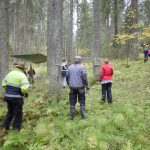
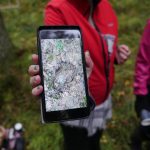
I visited most of the habitants of the road over the summer and interviewed them regarding their forest-relations. Invitations to this event where mailed last month and I delivered event brochures last weekend featuring a partial map. In the brochure I indicated that I’d meet with them at the end of the Degermossa road. People didn’t have to sign up in advance and I was very concerned whether any would come. It was ecstatic to see people arriving towards the meeting point walking the narrow road. Their participation felt like a gift. I offered people lunch, neatly packed in paper-bags and after a short introduction we hiked trough the forest.
The event was titled “The Forest Spring Affair” and I think I succeeded in the goals I set for it. Eventually 11 audience members came with me to the spring. The youngest audience members were 10 and the elders close to 80ties. The audience was chatting all thought the walk, they were curious and shared personal details on how they had moved to the Sipoonkorpi area and how their houses were connected to the surrounding nature. As a detail, one explained very exhaustively how water collects to their yard after rain, and forms a pool which is deep enough to swim in. An other told that their property had a spring, which in closer examination was revealed to be a well.
After a kilometre hike in a pretty but rough terrain we reached the spring… Which was dry. I’ve been visiting the spring frequently since 2019 and this was the first time it was void of water. There was no drinkable water in the pool. Viljami Lehtonen and I had visited the site the previous days, to transport our equipment to the site. Because the pool was dry, I took a bus to Tuulensuun lähteikkö in Vantaa and collected spring water from there. So, at Kurängen, I served the audience spring water collected the previous day from a different spring. This was a bizarre turn of events and people were humoured about it.
One artistic objective of the performance was to offer a ceramic vessel, made from the clay of the spring – Into the spring. I visited the spring early in the summer and tested the arrangement. As the earthenware ceramic jug (prepared during our Nomadic Kiln workshops) was submerged in the water it made a high pitch squealing sound. I wanted the audience to hear this sound which I presented to them as a “clay song”. When I poured water from Vantaa spring into the container… It did not make a sound! People were expecting a noise and as the vessel was silent, one noted: “It’s the wrong water”. I used the clay jug to serve people drinks, and after this I gave a short introduction of the exhibition and people walked around investigating the area.
Here is a recording from a previous session at the site:
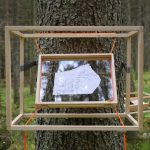
I presented the audience displays of mineral water related equipment, rock samples, maps, watches (reference to different time-scales), videos and pottery made from the Kurängen spring clay. I also exhibited the fabric I removed from the spring basin last year as an wall rug and Viljami treated us with a wet-ambient concert.
Sipoonkorpi (2022)
Sipoonkorpi Nomad house (2022) spring restoration
People were really disappointed that there was no water in the spring but understood that drought was to blame (the wells on their backyards had dried out too). The drought might give them motivation to visit the site later on. The display worked well and I think that as people were not expecting to end up to an art event, they behaved in a relaxed manner. Viljami started the concert while people were discussing. They told each others stories about the forest, about encounters with wildlife and dogs. One member wanted to show to the group how they had handled a close encounter with two unleashed German shepherds. As there were kids in the audience they went on mimicking how the dogs barked, and presented their choreographic retreat – How they walked backwards away from the dogs territory, keeping eye contact with them, while making angry faces.
An other told of their encounter with a predator. While hiking they heard a deep breath behind them. The sound prompted them to immediately walk home, almost running trough a swamp. Reaching home they learned that a young bear had been sighted close by. An other had pictures of bear footprints to show. Some audience members investigated the felt material I put on display and concluded that the fabric was natural. I will have to test it further.
It was delightful. The event lasted for two hours, people ate their snacks and had fun.
As the event was not framed as a “performance” people took over and entertained themselves. I introduced Viljamis gig as a “concert” but the weird looking modular setup possibly did not look at all like a musical instrument and the audience didn’t understand what was producing the sounds (if Viljami had a violin people would have behaved differently, the modular-synth instrument does not have similar authoritative appeal!). They possibly assumed they were playing a recording and kept on interviewing Viljami as he was playing. Viljami handled this really well, chatting with the curious while performing. A modular synth system in a forest, manifested unexpected low-key punk-ish aesthetics. It brushed against expectations of what a concert is and helped in keeping the event horizontal.
This experience built up to a bizarre revelation: Because people were not expecting an artwork, they made the event theirs. But it can also be that the event reinforced existing behavioural modes. I’m not sure if people were far out, out or in of their comfort zone. I’m not sure where I was either. It was weirdfun for everyone involved.
The event was a logistical challenge and an art-infrastructural spectacle. We carried the six art displays, built to fit neatly in banana-cardboard boxes to the site. We also transported a pair of Genelec speakers, a power-station (720 Wh!) and a modular system (which hosted the Benjolin I built last year). All of the equipment could be transported on one go. The boxes could be carried using a custom shoulder mount. The kilometre hike trough the forest with speakers, batteries, art and what-nots was a roadie-delight. The demands overloaded us and we didn’t experience fatigue: The event beat my expectations in every scale.
Below is the initial introduction to the performance from the Mad House programme.
Finland does not have any wilderness and we are better off without yearning for it. What would “wilderness” be like? Every tree, branch and stone in a forest is owned and used by someone. A forest is a site of negotiation and the noises we hear in it are proposals. The traces forest creatures and bypassers leave behind define borders between habitats and species. Accessing, passing and working a forest requires that we confront others. The confrontations can be scary and life changing. If you are interested in engaging in swampy-forest-negotiations, I invite you to visit a spring located at the border of a natural reserve and the emerging city. I will primarily work with citizens living closest to the spring but if they accept, we will share details of these encounters with broader audiences. The events will be organised deep in the forest.
I’m vulnerable to chaos magic. This is why I work with computers. I need spellcheckers, calendars and emails which organize my social life onto neat little lists which I can sort and search. All magic triggers chaos in me. I felt a spell passing as I turned a cabinet over in search of ibuprofen. I had to confirm there were white pills in hard plastic and soft foils, as a part of preparations for this weekends workshops. Pre-emptive ibuprofen prayer, as a preparation for chaosmagicallychargedlabour efforts is most adult thing I’ve done to date.
Form and function. I loved my M8 but it had too much form. I was struggling because it could conform to anything and I never felt satisfied by it. It constantly revealed my particular inadequateness as a listener and musician (human even). I swapped it to a Leploop 3v which has a lot of function, that I can only access partially due to its clunky form. This represents my inadequacies as efforts to form relationships with the instrument. I now know I don’t want to work with samplers, because samplers are heading from form towards abstraction. I want to work the opposite, from analogue circuitry towards sound. From this angle I’m better as an artist in failing with my technoish representation of nature (beauty), which is what electronic components and circuts are.