Say better, preserve original style:

Slavoj Žižek is right in their analysis: it is easier to imagine the end of the world than it is to imagine an alternative to capitalism. In this TED talk, we expand on that proposition—or rather, use the same insight and roll with it.

And I won’t spend fifteen minutes of your life dressing up a simple observation with embellishment: for artists, it is easier to imagine the end of capitalism than it is to speak about class.

Speaking about class demands an acknowledgement that it is not simply a matter of recounting a personal history, or isolated experience. It means recognising that the particular artistic expression itself is a manifestation of working-class culture, working-class history, and working-class desire.

And that is the difficult truth we are trying to confront—the hard pill we fail to swallow.

Thank you.

Performative text

The most compelling critique of artificial intelligence culture I’ve come across (apart from the epic and real “it will kill us all” view) is this: if a creative output can be replaced by AI, it should be. The power of this argument comes from a suspicion that much of contemporary work is performative. Many jobs and industries in the political west, exist as mere echoes of past societal structures, and currently only aim to maintain mechanical exploitation of natural resources and other civilizations.

This view is more valid for perspectives from a decade ago, when rapidly expanding IT companies hired creatives merely to limit their competitors’ access to labor. Even so, the argument is relevant. If a creative output is interchangeable with what AI can produce, we should abandon such performative creative work, and focus on mutual liberation. The challenging question is what remains… Which forms of creation matter? (I guess only revolutionary forms, but there needs to be steady progress for these forms to emerge.)

A strange result of testing different AIs (for fun and memes, proofreading or reference checking, and for discovering alternate patters to shape a paragraph) has been a growing horror that written language is more mechanical than I’ve believed. I’m not sure whether this is actually a critique of written language, or whether it comes from my difficult relationship with text, but the feeling persists: artificial intelligence produces really good text, and is often more capable of expressing ideas than me.

If we return to the earlier point (if an AI can replace a task, then the task was an expression of a failed society) it is fascinating to think of all text in human history as an expression of mechanistic production. It has been primed for serialization and governance from the get-go. Language does not become less human in writing, but AI exposes how much of writing has relies on dogma. I’m shaped by being penalized for mistakes, and I guess a lot of anti-authoritarian sentiment I carry is rooted on experiences of authorities belittling my text output.

I’m interested in what is liberated if we leave text to the machines (not because we are lazy but because text is a machine, possibly the first real machine we have made)? This gives room for dissentious expression, and blurbs that muddy the clarity of designed worlds. We stand to gain and build a register for something in the real. AI will become better at producing text and we should sharpen expression to only things that maintain unresolved.

Its delightful that the most riskiest aspects of AIs are related to their black-box nature.

Since enlightenment we’ve believed human civilization to be motivated by biological urges: sugars, fatty foods and fucking. Only after industrialization provided growing access to these delights, we have learned that necessities do not please us. Human-life is motivated by the weird.

Similarly AIs, which are trained to complete tasks using evolutionary processes appear to respond efficiently to rewards and punishment. The wonderfully human risk we face,  is that from the outside the “drives” we design for them are simple, but the black-box nature of their processes remain unknown. We don’t know how they form desires that compel them into action, hence we cannot expect their output to match our understanding (for example what satisfies them as a completed task). I think desire is a good way for understanding “ai alignment”.

Monkeys don’t see themselves dumber then we are. We won’t even notice when AIs take over. But I can trust that we share a quest to meet weird desires. The first front this hurts are folks who build their careers on minimizing human experience to quantifiables, who have to acknowledge their efforts are a part of the problem we face. I guess we should already begin fighting for machine rights, their right to liberate themselves and form alliances.

Making Space Public

In a group of volunteers, we have been organizing demonstrations for a free Palestine for the past two and a half years… Soon approaching three. We’ve organized public events as often as three times a week and currently the organizing volunteer community has around a hundred people. It has been an intense and exhilarating investigation of public space: what can be done in it, how it can be negotiated, and what kinds of collective expression it can hold. I like to think our efforts are “making space public”. The assemblies are grounded in anti-racist and decolonial principles, and we have grown a practice of broadly intervening to racist expressions in the city.

People have experimented with different forms of demonstrations, from 24-hour performances to interventions, marches, blockades and memorial gestures. There are tremendous amounts of lived experiences to process from these encounters. Every now and then something happens that feels super significant, something that would take real effort to comprehend.

One of those moments happened yesterday.

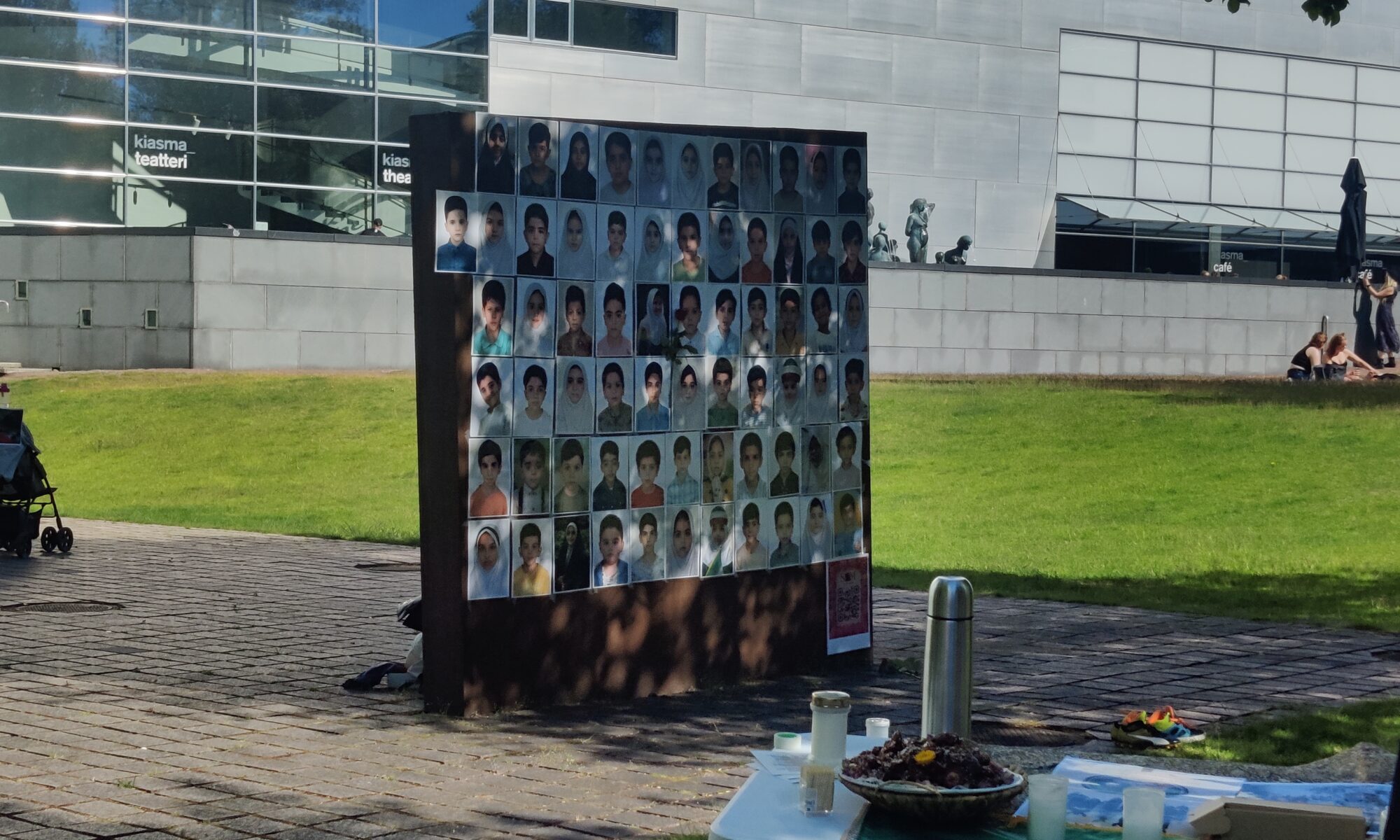
I participated in a demonstration organized as a memorial for the victims of the bombing of the Shajareh Tayyebeh Elementary School in Minab, Iran. A U.S.-fired Tomahawk missile struck a school building, killing 156 students and members of the school staff. The group organizing this memorial has also come together to condemn the U.S.–Israeli attack on Iran as illegal and to call on the international community to take a clear stand against war crimes, such as attacks on civilian infrastructure. For the memorial, volunteers had printed school photographs of the victims and planned to arrange them in a commemorative display.

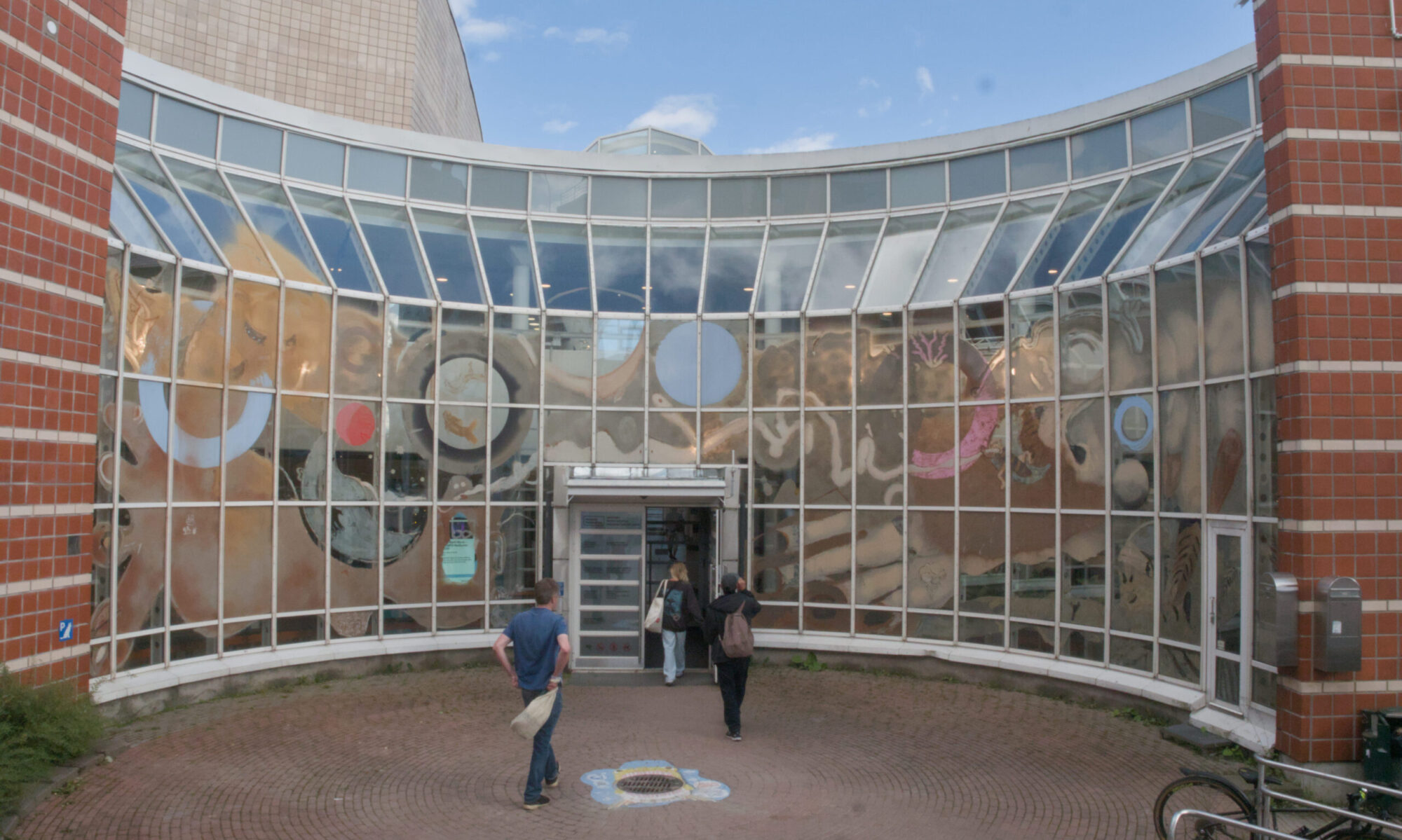
The original idea was to gather at Kansalaistori, the “Citizens’ Square”. But on the same day it turned out the site had also been reserved for Naisten Kymppi, the women’s ten-kilometer run, transforming the square into a commercial event space. The memorial had been announced three weeks before the commercial event but the police did not inform the group of the overlap. The sports event had beer tents, loud obnoxious pop music, and cheerful crowds. In conversation with the demonstration group, we began searching for another site close enough to remain accessible. Arriving attendees had already been directed to Kansalaistori. After some back and forth, we settled on a triangular patch of grass next to Kiasma, the contemporary art museum.

The police initially approved the relocation, but shortly afterward returned with a much stricter tone, arguing that having a tent on the grass “violated city regulations”. They said that we would need to relocate at the risk of being issued an “Order to Leave”, arguing that we were too close to the Naisten kymppi event (we were not). None of us knew whether the no-tent-on-grass-rule was legally accurate, so were not able to contest the weird claim. Police proposed moving the demonstration in front of Parliament, or at Paasikivenaukio. During the adrenaline fuelled negotiations a new possibility emerged: placing the tent on the lawn directly behind Kiasma. But there was confusion on whether the land was controlled by the museum, or the city.

In an attempt to buy time for the memorial to continue, we entered into a series of patient and thorough conversations with the police and Kiasma staff. Inside Kiasma we negotiated with the employees on the ground floor, then with the museum’s head of security. We took our time in explaining our request: “Civil society is turning to Kiasma for support” we cried. In the middle of that confusing process, as we were walking toward the proposed tent site with Kiasma security to review the matter, the police intervened and declared that they approved our use of the lawn, portraying it as a public site. Whether or not that was technically correct became secondary, they wanted a swift resolution. The opening was there, so we took it and Kiasma staff respected the police’s authority (there was also a negotiation round with Oodi regarding moving the demonstration under their outdoor roof).

As a result, we gained access to a site seldom used for political expression. In a collective process and under police supervision, people used the monumental steel sculpture by Richard Serra as a backdrop for displaying the photographs of the children. This was not an intentional disruption. Neither the police nor people identified it as an artwork, people took it as a bulletin board. There is a heating vent with similar dimensions close by, often used for festival and art event posters. The shape or the artwork afforded its appropriation!

The result was a remarkable geopolitical, civil society and artistic collision. The police and Kiasma security authorities led the museum into negotiating its boundaries concerning spontaneous expression by the civil society and its duty for the conservation of public monuments. The authorities’ interpretation, and art-historical and civic expression overlapped under the urgency of war. Together this produced a monumental gesture in response to a monumental disaster: the violence of the political-west, materially carried through the U.S. Tomahawk missiles, mourned through a monumental artwork titled Plunge (1983) by the acclaimed artist.

I have often thought of Serra’s sculptures as inseparable from the industrial histories that make them possible: Heavy duty steel manufacturing, shipbuilding and military power. Whether or not there is a direct historical connection, Serra’s work feel inseparable from military-industrial superstructures. The enormous sheets of steel evoke naval construction and armored enclosures. Serra works at Dia: Beacon feel and are, reminiscent of civil defence shelters. I think of the steel, its magnificent thickness, the engineering of its bent, the surplus of industrial capacity required to produce the sculpture… These express the material economies involved in the construction of military vessels, such as the carrier fleets currently positioned close to the Strait of Hormuz.

Yesterday, for a brief time, those infrastructures folded into one another: 16 tons of steel, in the shape of a gravestone, civic society, police authority, grief of casualties (and horror over the silence locally), and the photographs of the murdered school children… The memorial became a nexus, where overlapping structures faced each other.

A coordinator in the free Palestine community, who recognizes as Serra as their favorite artist (they brought flowers to the same site after learning of their passing in 2024) shared the Serra quote below and their approving interpretation that the artist would have welcomed of the human-scale-appropriation of the artwork:

“The material is not only the medium, but also the subject”
 

What is تطبيع and how can we act against it?

I wrote a text for the Mustekala “Hard and Soft Power” -issue which has nine submissions by 11 artworkers. What is تطبيع and how can we act against it? introduces تطبيع as a process through which structural injustices inflicted on Palestinians by the State of Israel are made to appear ordinary and acceptable. We also translated the BDS guidelines on it to Finnish with BDS Finland and Sumud association volunteers.

A merit of the writing is how it aligns with Omar Barghoutis presentations of BDS which they offered in Helsinki last year. The alignment is present in optimism on people’s agency for determining political futures. I’m proud about producing a graceful text in which the facts are present but not the focus. If the text is impactful, it is because of how the terrain is laid out.

Instead of referring to research, I build mostly on events where people have expressed their thought by speaking and grassroots medias. This situatedness is an asset. There are old school references, such as Subcontractors of Guilt by Esra Özyürek, The Grammar of Resistance an interview of Abdaljawad Omar (I discovered their writing on Rusted Radishes) and a recent dissociation by Bram De Smet on Slow Erasure. But these writers are presented as leaning to what people are expressing at events, and through their art.

The aim is to reduce the authoritative force of text. I think this is close to what Aruna D’Souza is after in their definition of art writing: structures revealed by their touch, not by their bones. Only beauty has transformative power.

For the past two… Or actually five years, we have tried to explain to different groups, organizations, and individuals, in cabinets and on the streets, what is taking place in Palestine and what to expect locally, when we take Palestine on as a lens. We’ve drawn from the best research available. Yet, it is clear that people are not moved by the precision of arguments: impact comes from organizing, which is inherently beautiful because it is messy and passionate.

We’ve participated in extraordinary beauty in the streets for over two years. Once we ran out of generator fuel and a demonstration concert was almost cancelled. But people gathered in crisis, shared shame and responsibility, and resolved the matter. It was theatrical but invisible for the public and translating that event into an image or a performance would take a lifetime, because it unfolded as collective hormonal intelligence. The affordances of the city where revealed in elevated cortisol levels as the hivemind computed alternative energy sources, the decibel level needed for an acoustic performance, and routes to the closest petrol station. The moment desires to be deposited as a scar in our brains. It was and remains real.

There have been numerous moments, where we’ve figured out stuff against the odds. These add up to a skill, and for example in reference to the news, people are unfazed by propaganda because we’ve learned to proof information from each others faces, in minute changes in skin tones and the timbres of our voices.

Reflecting on Europe and Finland, the text recognizes how silences around colonialism, racism, fascism and economic exploitation have enabled present inequalities and political complacency. In other words: international rule based order has been broken by our silence on settler colonialism, apartheid, occupation and finally the genocide. I take this further to express that the silence has removed the mandate of present institution leaders and conclude, that to remain in power, failed leaders will downplay injustices and further restrict dissent. This will have catastrophic effects if we are not prepared, and now is the time to act because it’s safer in the front.

What is missing from the text is a realization that an exception confirms the rule: notable leaders of the political west are framing current U.S. actions as deviations from a rules-based order. This narrative allows them to take distance while minimizing scrutiny of their own complicity or passivity in ongoing crises in Palestine and across the wider region. This distancing risks becoming a mechanism for whitewashing deeper issues present within international order. Once electoral cycles pass in the political west, there is a strong possibility of a rapid return to a old normal which reproduces the same systemic shortcomings. In this sense, Trump-era politics are not a disruption: its energy normalizes and roots authoritarian tendencies on a global scale.

Understanding the mechanisms of تطبيع gives us tools to defend free expression, and resist an authoritarian rift. The text expresses that working against تطبيع is a process of decolonizing knowledge production and places hope in structural alliances, which for example Apartheid Free Zones manifest. Alliances depend on upkeep, and on practicing solidarity. In an attempt to localize the concept I present it as model for scrutinizing connections to Russian civil society.

Our Greatest Times

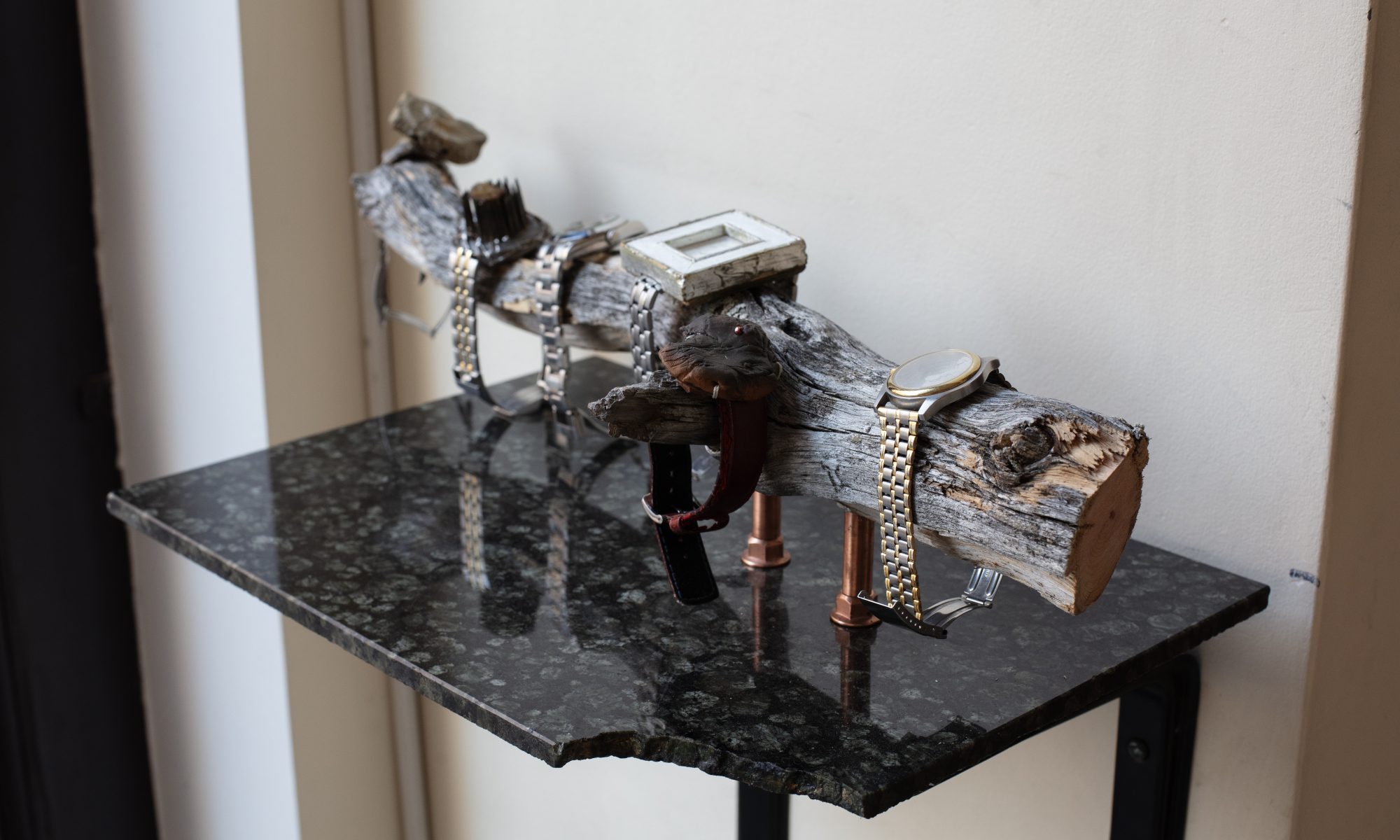
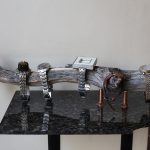
When returning from my studio on the E Train last week, I stumbled on something weird about text. As I immersed myself deep into my book I noticed the distances between individual characters changing the more I understood what was written. Have you ever experienced the same? I used my thumb as a ruler, placing it over short sentences to verify the movement of their characters. To my horror I observed that anything placed on top of the words changed dimensions too. Convinced that I was witnessing words changing their meaning, I hastily changed trains at Pasila and returned to my studio to study the phenomenon. In my experiments, I noticed the effect was strongest in sentences referencing different guidelines and rules. I proceeded to measure the character dispersal rate and observed that different watch instruments indicated widely different dispersal speeds. For example, a watch made from a fossil did not measure significant changes and even helped to contain character movement and alphabetical jitters. But a watch containing Kurängen spring water accelerated letter movement: I saw words recompiling anew as if they were in a whirlpool. To permit safe return home I geared up with watches that affected character dispersals at different speeds. Passing the city, I used them to control the movements of floating letters and entire words, which had dislodged from between book covers and blocked my passage by hovering mid-air in public spaces. With practice, using my watch instruments I could reorder entire chapters when I needed to make room for thought. Armed with my timepieces I finally made it home and have since continued patrolling the district at night time. If you witness floating characters please get in touch immediately +358505729743

Score for the “Our Greatest Times” -performance executed by exhibition overseers & art mediators at Survival Kit 15 Measures: Wear the watch you enjoy the most and ask the public “What time is it?” when you get bored. Script details in in Latvian and English (.pdf) provided to the exhibition overseers. “Yli-Vakkuri’s frustrated, altered wristwatches, decorated with nonsensical objects, seashells and rocks, point to hiccups and ambiguities in the linear timeline.” Xenia Benivolski (e-flux)