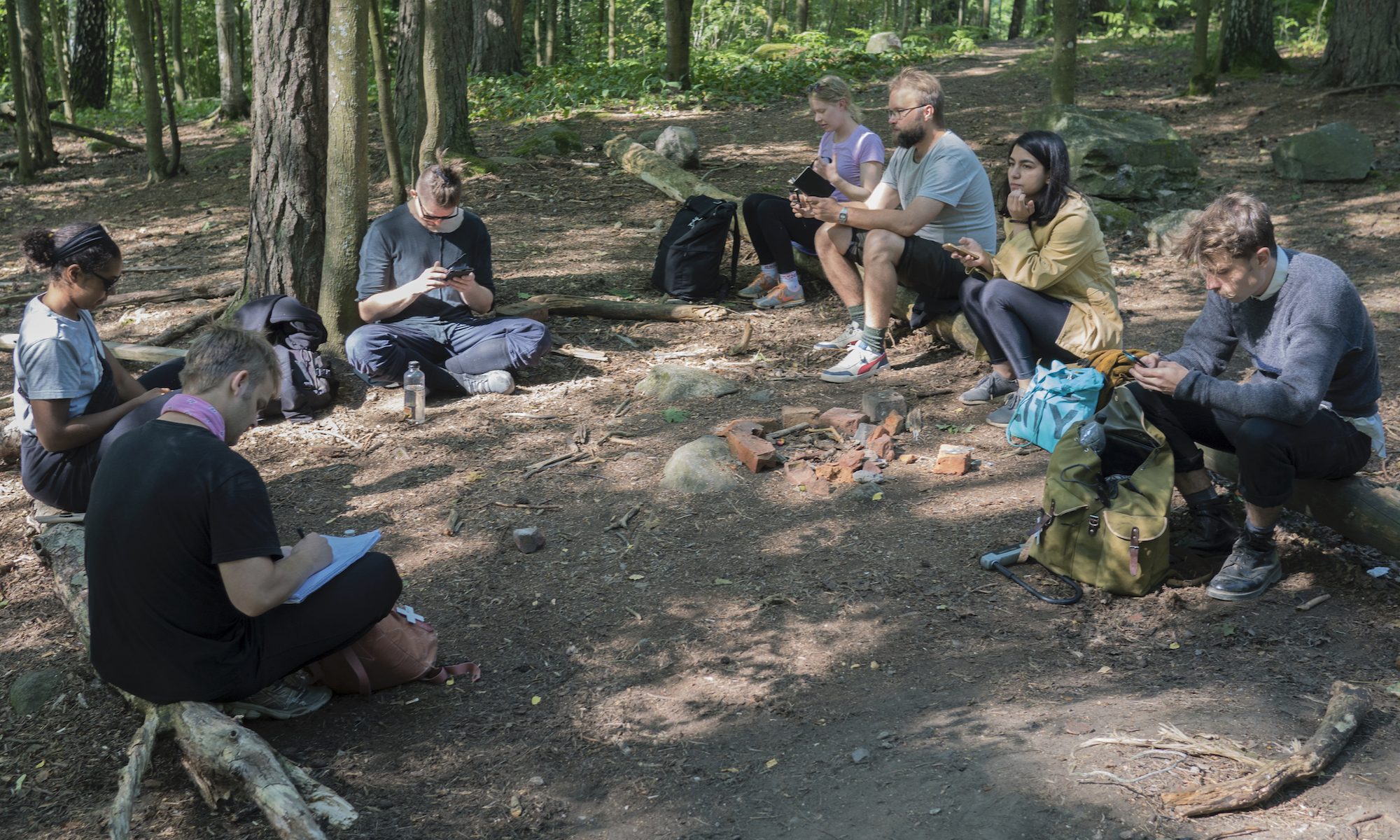

Visited Performance art event (called Performance art event) at the Exhibition Laboratory on Wednesday. The event was organized by Salla Valle and Timo Viialainen. Viialainen also performed in the event followed by Helinä Hukkataival, Michel Ruths, Yuan Moro, Linda and Aura and the night ended with a cute performance Viljami Nissi. The mood of the event was good and there were new faces in the audience. Ruths and Moro were new artist to me. Ruths had moonshine from his home town with him, which he offered to the audience before we sang swedish songs together. Moro performed a ceremony which seemed to mix Eastern Orthodox Church and Buddhists rituals. He also recited some sort of folk tales, he had a strong stage presence. Nissi presented a simple love-story using a horse themed song, condoms inflated with helium and scissors. I send him the On the Road with Trans-Horse mixtape after the event.
20180611
An artist in Helsinki who’s active on twitter has been writing a critical commentary of art-life, culture institutions and exhibitions for a half a year now. The blog is called Hampaat (teeth) and it’s an interesting albeit a tad cynical source for local art-news and art-thought. The most recent post is called YOUR COLLEAGUES ARE THE PROBLEM. The text feels like it’s very critical towards someone but that person is not identified… Which makes me paranoid (am I part of the problem? *laughs nervously*). The author identifies the figure of the “reputation avatar” (derived from the work of Gloria Origgi, a podcast about her book online) and tries to pinpoint moments were artists work primarily to maintain their reputation. I often engage with work to merely to maintain my reputation (but I don’t think it’s a bad thing).
The criticism of art mirroring our times (as a justification for the lack of critical thought and practice in art) is something I agree with. Elaborate media-artworks which I’ve seen recently (most of which are related to AIs) should be read as blatant celebration of media technology, innovation and capitalism (and not it’s critique). A hammer cannot be critical of a hammer #ॐ. The artist status should not be used as an excuse from ethical concerns: When artist use AIs they have the opportunity to be just as unethical as the übers and googles of the world.
The author is also critical of the recent trend of “melding art with science” and claims that “the situation of art as a site of knowledge is rotten at the core”. I agree to an extent. Artist are sometimes portrayed more pure hearted then they are. There seems to be consensus that artist would use science for the good of people if only given the chance. Which is not true – Artist are not healers. The text also makes me ask that why would anyone want to learn about Barad from an artist who reads Barad (if they can learn from Barad herself)? And to ask that in what circumstances is learning from an artist about Barad (instead of Barad herself) more efficient/better/smarter?
I’ve liked the THREE QUESTIONS TO PEOPLE DOING EXHIBITIONS UNDER CAPITALISM best so far.
Pietari shared a gruesome story from Amsterdam Dutch rewilding experiment sparks backlash as thousands of animals starve. A case-study for understanding the intersections of cross species solidarity and post-humanistic theory.
20180429
Epic warning and communication arrangements are being planned around nuclear waste repositories in hopes of educating people of the future. Expert Judgement on Markers to Deter Inadvertent Human Intrusion into the Waste Isolation Pilot Plan (1993) by Sandia National Laboratories for US Department of Energy is the most notorious example of how deep-time-communication efforts have been organised. They are trying to send a simple message to the people of the future:
Danger. Poisonous radioactive waste buried here. Do not dig or drill here before a.d. 12, 000.
Symbols and texts used to convey this information are difficult to design because we don’t know how people will communicate during the next 10 000 years. Questions in the Sandia report focus on whether the warning illustrations will be read from left-to-right or how people of the future will understand scale. These are problems inherent to all language translation efforts and because of these issues we should look for communication methods which use non-lingual tools. I’m reminded about the classic catchphrase told to kids learning how to edit videos and write short stories: Don’t try to explain what’s happening, try to show what’s happening and allow the audience to build their story (Show, Don’t Tell).
This is why we should make people who discover nuclear waste repositories sick from radiation as quickly as possible! This is the best way to show them that the sites are unsafe. Killing someone is a very unethical way to communicate – But it’s a more honest than trying to frame toxic waste caused by our lifestyle with educational mantras. All of the educational texts and warning symbols are just trying to hide the dirty truth: We lived at your expense. The radioactive waste is the message!
Onkalo should have a swimming pool of plutonium, made as inviting as possible. After the swim people would get sick very fast and learn that we were assholes do dump the our pollution on them. Only people who cannot read should be allowed to develop these kind of warning systems. Death is a message.
20180322
Visited an event organized by Jaana Laakkonen at Asematila space during the weekend. She read texts inside a tent structure which was constructed out of paintings. Works were also exhibited on the floor and some were stored in plastic bags (“for ease of transport”, I was told). She offered them for display on demand and flipped through canvases like a persian rug-dealer in a bazaar. Some pieces had been painted outdoors and were affected by mold. It felt like the mold was a sort of commentary on post-representationalism: The paintings study post-humanistic models of art making, while providing a habitat for non-human critters. The canvas serves as an image, a map, a diary and a Petrie Dish.
I was offered a brightly colored publication. It features close-up photos of painting materials (textures), glimpse of sites she’s worked at and partial outdoor scenes. The publication does not have any text in it and it feels like a sneak peak into an artists practice – Like peeping into a painters studio through a partially open door (intentionally opened by the artist). I also received three printed texts (folded inside the booklet). I’ve only read one: “Does Art Escape When Posthuman Performativity Enters (On [Not] Delivering it)” which is an intimate story about the artists relationship with a dog, bundled with a work journal of sorts.
The event and the texts emphasize entanglement (Referring to Karen Barad & Donna Haraway). This emphasis was present in the way that the artists mixed together intimate stories, technical depictions of the painting equipment and posthuman theory. I had difficulties in engaging with the event because of the artists the personal presence. It was as if she had constructed a zoo around herself. The intensity and intimate nature of the texts, the mold and the artists body predetermined my relation to the site. If the texts would have been read by an actor I could have roamed the stage more freely.
It was an inspirational event – It is as if she was painting with texts. Post-truth-realms have made the representational value of art weak, which is why contemporary art emphasizes on text and performance. Text, performance and bodybuilding exercises (working bodies against material weights) are essential tools to keep us grounded, to keep us in the same world or even to develop new common ground. Working with texts, weights and witnessing events require effort which is why knowledge they produce can be trusted.
20180320
The Black Panther was a good movie (for a Marvel movie). It is definitely a emancipatory experience for many but it’s definitely not a decolonial movie. It was fun to see how white characters are bashed on screen, told to be silent while the heroes of the story talk. White character were only used for comic relief and depicted as amoral and/or goofy. Some segments of the white characters story arcs were cut away and only mentioned through the heros dialogue (The event were CIA agent Everett K. Ross is locked in his room is not depicted on screen). The director Ryan Coogler is aware of what he is doing and not shy to show the reality which he has to work trough. The casino scene is a great example: T’Challa the king of the fictional Wakanda kingdom wins at the roulette wheel but a battle erupts before he can collect his winnings. A random casino visitor, depicted by Stan Lee casually collects the chips and cracks a joke while ripping him off.
Unfortunately the movie depicts muslims as savage kidnappers and offers a universalist techno-optimistic narrative. The Wakanda nation (an utopian African nation which is untouched by colonialism) has developed exactly the same technologies as their North American peers. Their military corps use remotely controlled drones for abroad military missions. They weaponize cars to pursuit their enemies remotely. The capital city of Wakanda is a mirror image of Manhattan, only color schemes and building facades look different. Wakandan scientist are shown to use medical technologies which penetrate bodies and produce 3D renderings of injuries.
As if unhinged innovation would result into identical technological development in every culture. There is a joke about this in the movie when Shuri (naïvely) invents a Wakandan version of sneakers (so that the Black Panther can move silently). The joke was fun until a quick search online reveals multiple franchise deals with multiple shoe companies, licensed to manufacture Black Panther branded footwear.
Despite the faults it’s great that a mainstream superhero film from Hollywood discusses colonisation and the history African slavery. As a part if the plot a museum is shown to falsify African history, so Erik Killmonger as a museum guest (a decent of a culture which artifacts are on display) reclaims the items from the museum (the museum staff is killed in the process). M’Baku the Man-Ape is a cool hero, he is proud to display his raw strength and savage attitude (the character feels like a direct comment to the H&M “coolest monkey in the jungle” controversy!). The movie plays on a binary reversal of stereotypical roles, which makes it difficult to sypher. Some parts feel like meta-critique of western-white-culture but the binary reversal somehow turns against itself. The movies fetisizes the US army trough the figure of Killmonger: The characters military merits and killcount are casually drooled on.
The most radical part of the movies was a scene where T’Challa and Okoye (Bodyguard from the all-female special forces of Wakanda) negotiate with CIA agent Ross how to organize the interrogation of a prisoner. The agent informs them that the CIA will handle the situation and advise them to stand down. T’Challa and Okoye ignore him casually, they don’t even understand what the agent is saying: They can’t even imagine taking orders from a representative of a foreign nation – They can’t imagine a reality were whiteness grants authority.