20200429

Oh.. What a weird and wonderful night. I was exited about assembling the walky-talky modules and went on imagining of scenarios I could use them in. An idea gloomed.. What if the module would work in FM domain? I’ve been making radio experiments with my raspi (see Hammeradio) and the itch to send wireless signals is an old one. The question led me on a frantic internet search stream and eventually I run into a website I visited years ago: Polimorphous Space by Tetsuo Kogawa. I learned about the site from Diego Cruz Martinez an activist/engineer who worked for/with Radio Oaxaca. I interviewed him when I was working for M2Hz and the interview in available Finnish: Ääni intiaanikylille (2009).

Kogawas site is fascinating. There are texts and interviews dealing with the work of Félix Guattari (whom Kogawa met in 1981), manifestos and poetry, bundled with technical notes and schematics. The radio art guides he offers are thorough and the radio transmitter builds seem very robust. Here is a quote from his Micro Radio Manifesto (2006).

Today, our microscopic space is under technologically control and surveillance. Our potentially diverse, multiple nad polymorphous space is almost homogenizee into a mass. Therefore we need permanent effort to deconstruct this situation. In order to do this, to use a very low-power transmitter is worth trying. Small transmitter can be easily made by your own hands. [SIC]

This is a direct call for action and aligned with the texts he offers, this sets a clear trajectory for critical radiophonic work! The looks of his builds are wonderful. He uses an adaptation of “Manhattan style” method in his circuit construction (some notes on the style on Parasit Studio blog). The name Manhattan style reflects the street grid and urban planning of Manhattan, New York and I guess it links to the era of the Manhattan project too.

I’m now dreaming of building an eurorack unit of “the standard model” transmitter in Manhattan style. Some components are rare (2SC2001 transistor) but he also offers plans with alternative components (BC337 transistor). I imagine that in a rack the transmission would cause a lot of noise and interference but the build is conceptually firm. I think that as a module it reflects and is a call for the “responsibility of speech”. I’ve come to believe we have a responsibility to make sound, to voice opinions so that we do not collide to each other. This idea is well drafted in a boating story I heard from Topi Äikäs. In short: “If everybody is silently looking for the truth, nobody is safe!”. I could etch this story on the PCB.

After an exiting couple of hours in the world of Kogawa, I realized that the module should also include a receiver: Whats would be the point in making noise if no-one can listen to it. After some search I found this Simple FM Radio build (credited to Charles Kitchin) which is simple and runs on the same voltage as the transmitter (the unit in the photo is also build in Manhattan style). This means both builds could be powered from the same supply! I’ll have to experiment if this will cause too much interference but the idea is clear. The module could have one input for transmitting and one for receiving. With two modules, two (or more) racks can be made to work in unison.

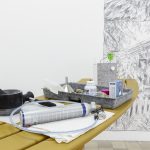
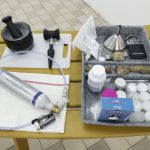
An additional bonus in the transmitter build is that I could use DIY mineral water capacitors (which I experimented with on the Simple EQ build) for setting the transmission frequency (it needs a variable capacitor between the values of 10 to 20pf). This is perfect because when working on the walky-talkies I felt horrible remorse for not continuing to develop/build modules I’m planning to use in upcoming mineral water performances. Suddenly a side quest to radio transmission domain proofs meaningful and everything makes sense for a while.
20200413

Build a TrAniModule amplifier/speaker using a PCB from the designer. I mounted it to a wooden panel, fitted it with a 1.5W speaker and added it to my Water Lab rack on modular grid. Sounds great, has a nice distortion and the module design is very versatile. My build is featured on the Animodule Facebook page and nicely titled a “gorgeous customer build DIY”.

Next I plan to build three piezo amplifiers in 1u size PCBs which I can mount to a 3u panel if needed. They will be used to amplify the sounds of sparkling water in upcoming mineral performances. Also sourced components for a 1u wavefolder and a MMI USBpower build.

20200323

Performing the Fringe exhibition at Konsthall C was rewarding to setup. Most of the artists in our group came to Stockholm, where we were warmly welcomed by Erik Annerborn & staff. On site we had the pleasure to work with Kaisa Sööt who had designed the exhibition architecture. She had build wavy-benches based on a park seating design spotted in Hökarängen. A localized furniture architecture development effort (reminded me of NCD-C swingers club designs).

I arrived a day before my performance to extract samples from stone architecture using kitchenware from Ikea. A meat-hammer served as a mallet and a regular table knife as a chisel. I pulverized the rocks using a Ikea stone mortar & pestle. The powder was gray and dissolved (seemingly) well into the water (0,3 mg per liter). Polukord noted that granite ore contains metals which caused some concerns (I wonder if it’s possible to separate metals from ore using a magnet?).

My portable CO2 regulator worked well and produced ~5,5 bars of pressure inside standard 1,5 liter plastic bottles, which I used for water-to-gas agitation and serving. The gas was from a local shop which stocks consumer grade 475g CO2 tanks (CGA320 treads). Interestingly the plastic bottles stretched when I added pressure and when shaked the plastics retraction would add to the pressure, causing the content to retreat back towards the regulator. In my first rehearsals this counter pressure caused the valves to come loose.

The next day I performed for a private family which lives in the district. The family connection was facilitated by Annerborn, who introduced me to them in person before the show. I executed my performance in the family’s kitchen. I had some trouble with my sound system, the shape of the space caused a feedback loop, which was hard to resolve. I attempted to do the talk bits in Swedish (my Swedish language skills are fringy, which works well with the project theme) but turned to English midway and the kids lost interest soon after. My statuesque warm-up dance moves were constantly commented by kids, which made pacing difficult. The performance was a delightful mess.

The family was very concentrated on the presentation. I had some minor problems maintaining cohesion, the event challenged the artistic integrity of the piece in a good way. A beneficial learning opportunity and I think the family enjoyed the chamber performance too. We chatted a bit after the performance and they showed their backyard. I was donated a piece of rock from their garden and prompted to make mineral water from it.

The coronavirus didn’t change the performance much. At the time there was no social distancing etiquette guidelines in place in Stockholm (a week an a half ago). We did maintain a little more distance then normally and I executed extra caution in the water preparation. If the family would have wanted I could have made the performance outdoors, in which case it would have been a typical lecture-performance.

Our exhibition opening was cancelled, even so there were some 10 visitors at the space for the opening. This was just enough for setting the mood and actually made the social situation more dense than normal openings. The fewer people there are the more focus they demand. Performances for big audiences are more relaxed because the crowd behavior is more easy to react to than individual gazes. I prepared different waters for the guests and people were exited to drink them (particularly the gravestone water). When walking back to the hotel we shared a pleasant chat with Alexey.

Katarina Frifarare had a parallel opening in the Konsthall C Centrifug space. The Centrifug can be booked for exhibitions by anyone and the dates of the show are set randomly. We should have something like this in Helsinki too, in the Taidehalli space? Frifarare’ exhibition was a leftist analysis of women’s textile work and made a good match with our exhibition.

20200306

The racist and fear mongering Finns Party is normalizing a process were people in power use linguistic loopholes to embed racial slurs and toxic opinions into public statements. Its an infantile method for seeking attention. Like when a parent says “Don’t walk indoors with your muddy shoes” and a rebellious child responds by jumping around while shouting “But dad I’m not walking!”. Instead of saying what they mean, they say imply what they mean and if they are called out, they engage in pedantic shenanigans to normalize slurs. This toxic jargon is now used by the UROS company as a response over critique of the naming process of a controversial sports arena in Tampere.

The company name UROS stands for MALE in Finnish and its staff consists of 26 males and two women. They are the main sponsor of the arena and have decided to name it UROS LIVE. As a response to critique over naming a gigantic urban development project as MALE, the company representative claims that the name “does not have anything to do with gender”. The spokeperson-manchild insists the name is a mere abbreviation of their English name “Universal ROaming Solutions” (which they chose for the company). This process is a good example of what happens when rich people extend their economical dominance to infrastructure.

If I keep drinking mineral water made from Finlandia Hall marble I’ll replace the calcium in my bones with the building and effectively become a building myself. If I read wikipedia correctly it’ll take 10 years for my bone minerals to be swapped. Currently my weight is ~2mg Finlandia Hall. Not all of the calcium I’ve drank will absorb to my bones but still… An interesting side-effect worth exploring. Eventually I might start hosting seminars in my body.

Preparing for Konsthall C gig and exhibition. Using kitchenware bought from Ikea for rock & mineral sample extraction tools, modified a speaker to play rock extraction sounds periodically. Made the speaker interface pretty using a novel silicone-molding technique. Worked with it like plaster and dyed it green (diy orthopedic skills were deployed). Had a pleasant chat with Moa Tunström who gave us a really thorough introduction to the Hökarängen district during our visit there. I’m still processing the interview material. Her input feels valuable for a performance architectural analysis of the district.

Saw Grâce by Anna Torkkel at Kiasma. The piece was a celebration of the diversity of movement and worked well for inspiration. I laughed trough the show and the sound design was great. But driving back home I felt puzzled. The contemporary dance I see in Helsinki feels a praxis were people take turns in watching each others move in freely.

20200214

The Mazizone local network archive I’ve been setting up for my Raspi3+ is stable and working well. I have occasional problems connecting to it and I need to “forget” the network to reset certificates. But this only happens when I’m login in and out intensively for tweaks & edits. The device reboots daily to prevent these kinds of clogs. I haven’t gotten Gammu (to produce daily status updates via sms) working but with the reboot cycle enabled I’m confident that the device will run well enough.

I build the sound archive using wordpress and it looks fresh. Using wordpress in Mazi causes issues with the network url but this is manageable (it redirects visitors to portal.mazizone.eu which is ok for me). I’m now planning to build a funky case for the device and to make an inviting sign which will guide visitors to the network and archive. While making the website I got the idea of using ornamental patterns as illustrations. I also used ornaments in the eurorack case I build for the trip. When I was designing the case I tough the Byzantine style decorations as a reference to early natural sciences (which my work on mineral waters touches). This spawned the idea to add ornamental figures to the thumbnails of the sound files in the archive.

Each sound file (53) has a unique photo assigned to it. The photos set a mood for the content and give a hint of the sound. Photos were shot during our train trip by Iona Roisin, Elina Vainio and Miina Hujala. On top of each photo is a layer of different ornamental shapes. They twirl around the thumbnail corners and interact with things and people in the images. I’ve used Kid3 to add the images to the .wav files. If I’ve understood correctly .wav’s don’t have thumbnails but Kid3 manages to embed the data anyway. The default wordpress media playlist widget can source the images from the files and display them next to the track info.

Now there are ornaments everywhere!

I like over the top ornaments which have an abundance of detail. In Russia I can spot them everywhere. They are used in architecture (Corinthian pedestals and window frames), street lamps, fonts, advertisements, jewelry and clothes. Sometimes the patterns look familiar. Shapes I’ve seen in Russia appear to fuse Byzantine style decorations with folk ornaments I worked with during my carpentry studies. I can recognize a patterns being identical to a traditional woodcarving I’ve seen in Finland. Pirtanauhat and kauluslaudat are good examples.

I guess ornaments appeal to me because they link traditional Finnish crafts with Byzantine history and even contemporary Islamic and Arabic cultures. We visited a folk culture museum in Kazan and many of the Islamic artifacts in the collection looked similar stuff I’ve seen in Finnish folk culture museums (particularly the wooden objects). Some of the clothes looked like something my mother would want to wear. Styles I link to Bedouin folk gowns that are decorated with coins, felt really similar to Russian military uniforms which are decorated with medallions.

The ornaments I’m using for the archive and the thumbnails remind me of weeds. I think they link the archive to “ruins” which Miina is interested in. I think ornaments should be read as celebration of decay. They simulate nonhuman futures by imagening how plant life will take over architecture. They feel like archaic glitch art! Sometimes ornaments in clothes look like roots or blood vessels. I think Scandinavian design aesthetic read ornaments as a vanity but if we approach them as a celebration of decay there is nothing vane in embracing them. I hate Scandinavian design because it makes me feel ashamed of my appetite for details.

Using ornaments to decorate a sound archive, which is difficult to access – Feels right and embedding weed-like ornaments inside metadata makes sense. Here is a low-resolution sample of what the archive looks like when browsed using a mobile phone.