
In a group of volunteers, we have been organizing demonstrations for a free Palestine for the past two and a half years… Soon approaching three. We’ve organized public events as often as three times a week and currently the organizing volunteer community has around a hundred people. It has been an intense and exhilarating investigation of public space: what can be done in it, how it can be negotiated, and what kinds of collective expression it can hold. I like to think our efforts are “making space public”. The assemblies are grounded in anti-racist and decolonial principles, and we have grown a practice of broadly intervening to racist expressions in the city.
People have experimented with different forms of demonstrations, from 24-hour performances to interventions, marches, blockades and memorial gestures. There are tremendous amounts of lived experiences to process from these encounters. Every now and then something happens that feels super significant, something that would take real effort to comprehend.
One of those moments happened yesterday.
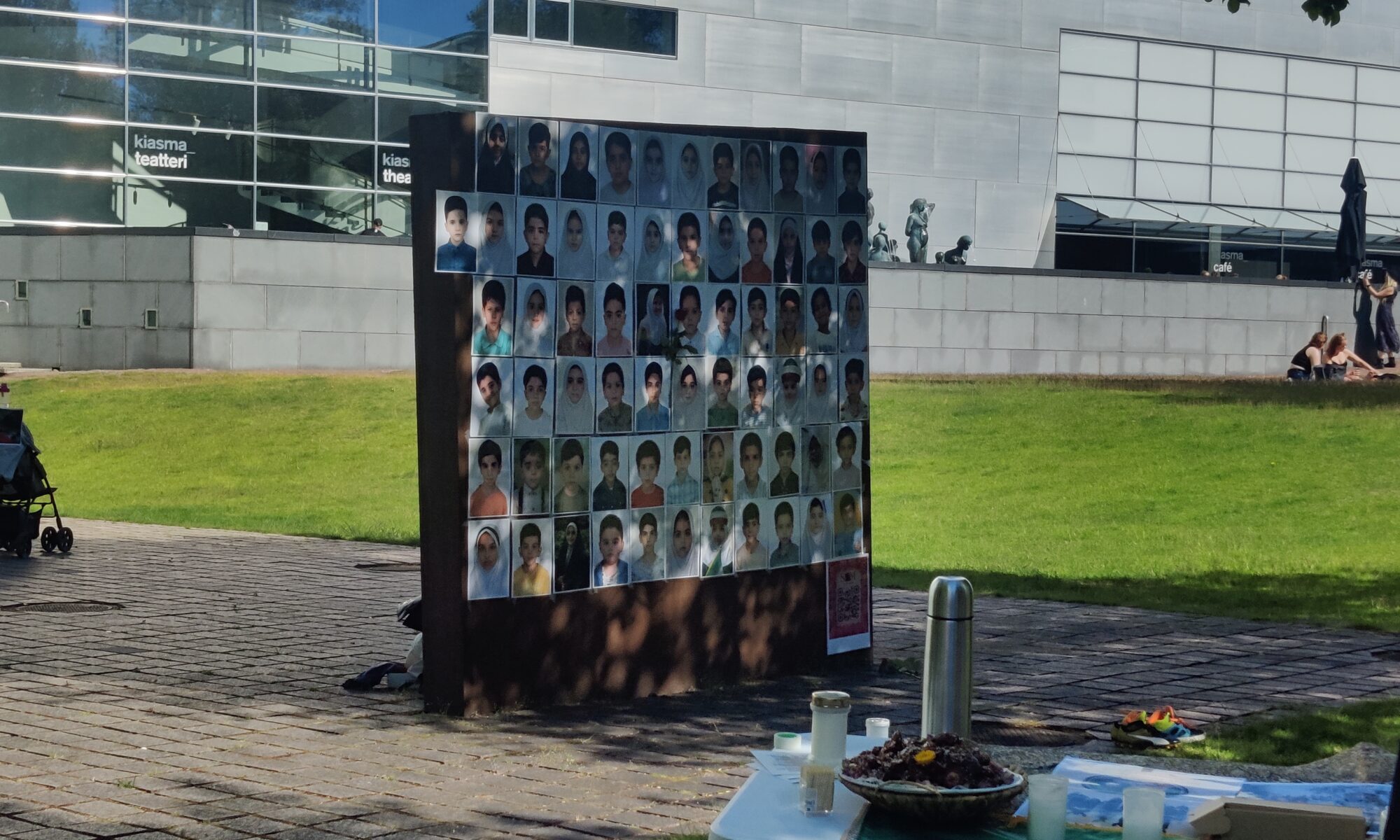
I participated in a demonstration organized as a memorial for the victims of the bombing of the Shajareh Tayyebeh Elementary School in Minab, Iran. A U.S.-fired Tomahawk missile struck a school building, killing 156 students and members of the school staff. The group organizing this memorial has also come together to condemn the U.S.–Israeli attack on Iran as illegal and to call on the international community to take a clear stand against war crimes, such as attacks on civilian infrastructure. For the memorial, volunteers had printed school photographs of the victims and planned to arrange them in a commemorative display.
The original idea was to gather at Kansalaistori, the “Citizens’ Square”. But on the same day it turned out the site had also been reserved for Naisten Kymppi, the women’s ten-kilometer run, transforming the square into a commercial event space. The memorial had been announced three weeks before the commercial event but the police did not inform the group of the overlap. The sports event had beer tents, loud obnoxious pop music, and cheerful crowds. In conversation with the demonstration group, we began searching for another site close enough to remain accessible. Arriving attendees had already been directed to Kansalaistori. After some back and forth, we settled on a triangular patch of grass next to Kiasma, the contemporary art museum.
The police initially approved the relocation, but shortly afterward returned with a much stricter tone, arguing that having a tent on the grass “violated city regulations”. They said that we would need to relocate at the risk of being issued an “Order to Leave”, arguing that we were too close to the Naisten kymppi event (we were not). None of us knew whether the no-tent-on-grass-rule was legally accurate, so were not able to contest the weird claim. Police proposed moving the demonstration in front of Parliament, or at Paasikivenaukio. During the adrenaline fuelled negotiations a new possibility emerged: placing the tent on the lawn directly behind Kiasma. But there was confusion on whether the land was controlled by the museum, or the city.
In an attempt to buy time for the memorial to continue, we entered into a series of patient and thorough conversations with the police and Kiasma staff. Inside Kiasma we negotiated with the employees on the ground floor, then with the museum’s head of security. We took our time in explaining our request: “Civil society is turning to Kiasma for support” we cried. In the middle of that confusing process, as we were walking toward the proposed tent site with Kiasma security to review the matter, the police intervened and declared that they approved our use of the lawn, portraying it as a public site. Whether or not that was technically correct became secondary, they wanted a swift resolution. The opening was there, so we took it and Kiasma staff respected the police’s authority (there was also a negotiation round with Oodi regarding moving the demonstration under their outdoor roof).
As a result, we gained access to a site seldom used for political expression. In a collective process and under police supervision, people used the monumental steel sculpture by Richard Serra as a backdrop for displaying the photographs of the children. This was not an intentional disruption. Neither the police nor people identified it as an artwork, people took it as a bulletin board. There is a heating vent with similar dimensions close by, often used for festival and art event posters. The shape or the artwork afforded its appropriation!
The result was a remarkable geopolitical, civil society and artistic collision. The police and Kiasma security authorities led the museum into negotiating its boundaries concerning spontaneous expression by the civil society and its duty for the conservation of public monuments. The authorities’ interpretation, and art-historical and civic expression overlapped under the urgency of war. Together this produced a monumental gesture in response to a monumental disaster: the violence of the political-west, materially carried through the U.S. Tomahawk missiles, mourned through a monumental artwork titled Plunge (1983) by the acclaimed artist.
I have often thought of Serra’s sculptures as inseparable from the industrial histories that make them possible: Heavy duty steel manufacturing, shipbuilding and military power. Whether or not there is a direct historical connection, Serra’s work feel inseparable from military-industrial superstructures. The enormous sheets of steel evoke naval construction and armored enclosures. Serra works at Dia: Beacon feel and are, reminiscent of civil defence shelters. I think of the steel, its magnificent thickness, the engineering of its bent, the surplus of industrial capacity required to produce the sculpture… These express the material economies involved in the construction of military vessels, such as the carrier fleets currently positioned close to the Strait of Hormuz.
Yesterday, for a brief time, those infrastructures folded into one another: 16 tons of steel, in the shape of a gravestone, civic society, police authority, grief of casualties (and horror over the silence locally), and the photographs of the murdered school children… The memorial became a nexus, where overlapping structures faced each other.
A coordinator in the free Palestine community, who recognizes as Serra as their favorite artist (they brought flowers to the same site after learning of their passing in 2024) shared the Serra quote below and their approving interpretation that the artist would have welcomed of the human-scale-appropriation of the artwork:
“The material is not only the medium, but also the subject”