I don’t know much about leadership but I do know about teaching and have worked in self governed groups. I assume that leadership and teaching are related and suspect both are about balancing listening to others and articulating personal desires. Both require accountability. I’m curious about leadership which would be structured by values.
Value based leadership sounds better in Finnish: Arvojohtaminen. In Finnish the term sounds like it’s not only about leaning on shared values of a work community for defining organizational goals but equally about defining values and imagining futures where the values would prevail. For me politics is about calling forth a public from the mass of folk we’ve been made into by history and deciding where to head next. Value-based leadership or rather leadership by values would then be a process of reaching to this public, to remind each other about shared ambitions and dreams. We are all worried about the future which is why being reminded why we are working together gives hope and comfort.
Leadership which is set by values is scary because one might fail in articulating the ambitions and dreams a community shares or even worse one might reveal that their values are not inline with the current mood of a group. This gives the public just cause to scrutinize the speakers role in the organization. I imagine this is why hierarchical organizations are seldom led with values, the democratic processes of constant reevaluation would strain them. Hence the group is steered by a “mission” which does not require individuals working to achieve it to share (or commit to work on) values. It’s enough that members are managed, that the time and budget they spend gets measured. The aim is to work in a fluidity where no one needs to think or say what they believe in. Work is viewed as something not political.
Just as the terrorists wanted, everyone else was left feeling unsafe.
The Kankaanpää terrorist group was caught during the same time I was teaching a performance art course for first semester students at the Kankaanpää Art School. News of the arrest came to light on a Sunday, halfway through our intensive course. The far-right group, consisting of five young men, was defined as an accelerationist cell and it was broadly speculated that they had been planning an attack. Any potential target they might have had has not been revealed by the police. I continued with classes the following week and referred to the arrest in anecdotes but didn’t engage with the news systematically. Not a lot was (or is) known of the group’s intentions. There were rumours circulating that the school could have been a potential target because members of the terrorist cell had attacked students a few years back.
Students were stressed and very critical to how the school and I were addressing the situation. It must have appeared that we, the staff were intentionally silent about the affair. We had a crisis talk with the student group on Wednesday and on Thursday the executive director, rector of the Satakunta University of Applied Sciences (SAMK) Jari Multisilta held a meeting for all the Art School students and staff. Students voiced their criticism and desires bravely. They wanted the school to respond to the news and to take their concerns seriously. The meeting was followed by a session next Monday facilitated by art department team leader Matti Velhonoja, where students and the staff could further discuss and share their feelings. Both events worked well for voicing concerns and coming to terms with news. But discussions in both forums focused on technical matters: What kind of security measures or protocols should be implemented, how frequent should emergency evacuation drills be held and should student privileges, such as having access to school woodworking facilities after hours, be revised.
I think the focus on technical matters is a symptom of a deep issue: When leadership is not rooted in values, concerns over safety get handled by discussing technical matters. In short, instead of using the public forums we had for strengthening our sense of solidarity and confronting terror, we discussed whether more security cameras should be installed on the art school campus roof. Retrospectively, we were petrified by the potential of violence and resolved our unease by dabbling with optics. Discussing right wing terror, the threat students feel in Kankaanpää or in the becoming Finland and how should we organize to combat fear would have required work. The outspoken students who provided the strongest criticism of the school institutions response, detailed that their views were rooted in prior experience with right wing extremism. I believe that if the terror threat and the experiences students have had would have been discussed in an unhierarchical manner —leaning to their expertise— we could have reached something immensely more constructive.
This would have required us all to commit to the school from a different, perhaps deeply personal stance. It felt like none of us in the staff had a mandate to fully address the needs of the students. Even so, instead of retreating back to a numbing fluidity where differences are pushed aside with managerial apparatuses, we should use the momentum for reframing our ambitions and dreams: What do we want from art and art education when faced with terror? Where do we want to head from here? The only sign of a fighting spirit in the sessions was a cry “No Nazis at Kankaanpää, No Nazis at all” by Antti Ahonen. It felt energizing but did anyone believe it? Who amongst us was committed in confronting terror and how would our efforts be most effective?
Its not a coincidence that the terrorist cell was formed in Kankaanpää, the region most supportive of the far right Finns party and it is horrible that locals who have been interviewed by nationwide media outlets have downplayed the severity of the case. When the terrorists were released from pre-trial detention, a local Finns representative Teuvo Roskala published a post in which he celebrated their return to Kankaanpää as if they where national treasures. In this landscape the art school is a beacon of hope for young artists. Discussions with SAMK department heads framed the art school as a “bubble” which is dislodged from its surroundings. This was offered as a partial explanation for the sense of alienation students expressed. This should not be a mindset for reading students reactions.
Security devices will not resolve the problem, because the problem isn’t security, the problem is the prevailing managerial ethos which enables organisations to function without articulating values they are working for. The city of Kankaanpää and SAMK should layout measures they are planning to deploy in-order to countermeasure the increasing far right threat. The Finns party’s reactions to the terrorist case should be publicly scrutinized by people who lead public institutions, in areas where they have been voted into power. What does SAMK dream of in the wake of these events?
On a broader scale I want to investigate how art education should respond to rising right wing extremism. What does it mean to be an art student in a hostile environment? If fear is not confronted and the sense of security strengthened, the process will cause immeasurable harm. Can or should we work towards establishing pedagogical guidelines for confronting violent political movements? Education is nothing but political. It is an expression of a humanitarian belief that personal and societal change is possible. Every teaching event is a sincere attempt to become better, more just, more grounded and that we will achieve a brighter future by becoming more compassionate.
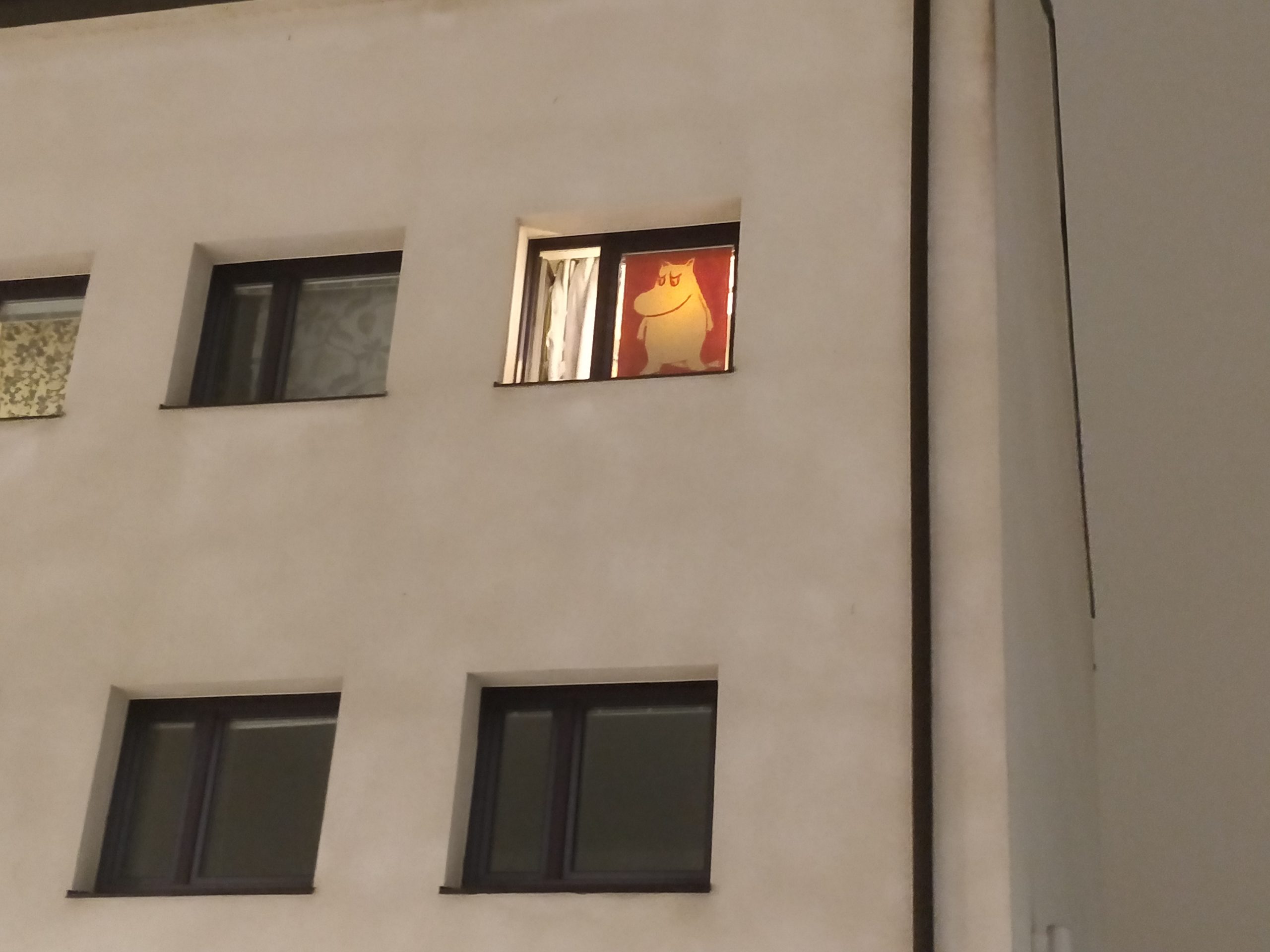
I also remembered writing about Kankaanpää and the Finns Party a few years back. There is a definite trajectory between Finns-party and far right extremists, which should be taken seriously. The following week I draw an angry Moomin character and attached it to to the window of the staff flat overseeing the market square from where it condemns violence. It’s not much but it’s what I could do.