20180828

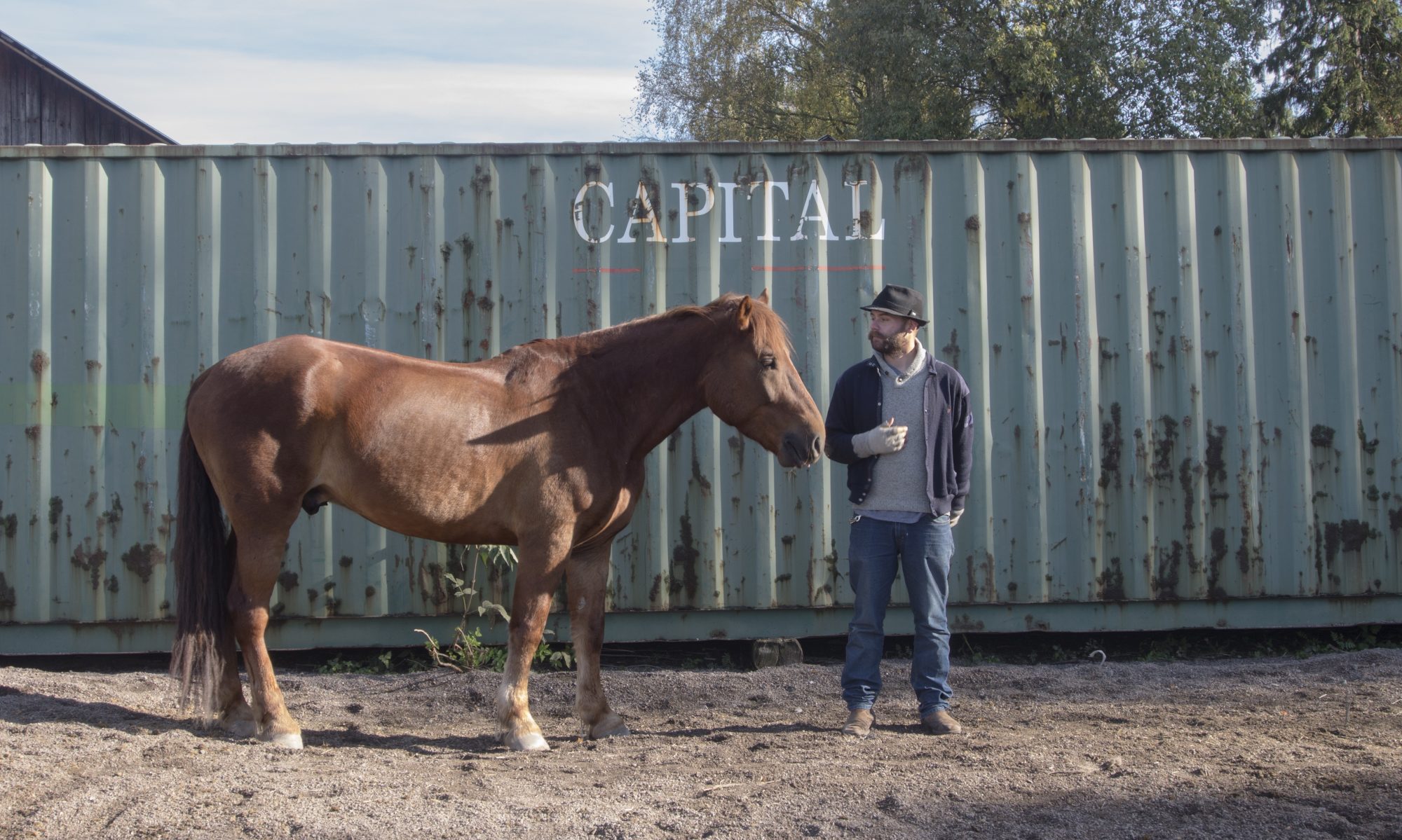
Got on a trail ride at the Bronx Equestrian Center, Inc. yesterday. I was guided by Susie, who rode her horse Storm. My white horse was called Mystic the Percheron, who has also starred in The Greatest Showman. The trail took us around the Thomas Pell Wildlife Sanctuary, following the border of a golf course. The forest felt like a jungle, vines covered the trees, the phragmites were sky hight  and we saw deer while passing a creek. Reaching the stables was the hardest part, the ride went smoothly and after the trip I got to wash a few sweaty horses.

How Should a Museum Be? (2018) Stefan Kalmár. An honest plea to make museums more vital. Unfortunately I don’t think that museums have ever been made with good intents.

[…] in the 21st century, ideology and power manifest themselves primarily in the realm of the visual, rather than the textual. Hence, the removal of arts education is tantamount to an institutionalized programme of (visual) illiteracy.

What would it look like if a major museum engaged in the development of self-sustainable, well-designed, social housing projects rather than lend its name to a tower of luxury penthouses – as with New York’s Museum of Modern Art and the lavish 53W53 building? Our economic set-up today is geared to look to where the money is, not to where it isn’t.

20180826

Saw a eye-opening graffiti from the window of the G-train.

IN AN ECONOMY THAT YIELDS PROFITS FROM PEOPLE’S LOW SELF ESTEEM; FEELING GOOD ABOUT YOURSELF IS A REBELLIOUS ACT.

I was taught that critical art is “participating in discussions in order to show how unjust particular discussion are”. I was taught to welcome the hurt – So that the audience could witness how unfair and evil the world is. This still makes sense to me… But I know it shouldn’t.

Kassutronic is designing neat eurorack modules.

Why a leading political theorist thinks civilization is overrated (2018) Sean Illing. Interview of James Scott, author of In Against the Grain: A Deep History of the Earliest States (2017). They talk about de-development!

JS: […] the standard narrative is that once we had domesticated plants, then we immediately shifted to an agricultural society so that we could stay in the same place […] But that’s not quite right. Four thousand years passed between the first firm evidence of domesticated plants, cereals, and the beginning of truly agrarian communities that are living largely by agriculture.

[…] hunters and gatherers spend only about 50 percent of their time producing or searching for what they needed to survive. The idea that hunters and gatherers and foragers were living hand to mouth and one day away from starvation is nonsense […]

20180823

Schematics and a guide on muffwiggler.com and doepfer.de for nifty 5v gate -> S-trigger converter, which might work on the Boss RC-30 tap tempo (and any other Boss pedal with a tap-tempo). I’m tempted to try this even tough I’m not using my RC-30 as much. Here is a better plan Slacker’s midi clock metronome PLUS tap trigger (S-trigger is not for switch toggle action!). After a furious night of internet search I learned of the Thomas Henry Trigger-to-Switch Project, which uses a 5 VDC dpdt dip relay relay to convert a +5v (5ms) into a switch toggle action. Also considering making a Panasonic/Lumix camera remote using these schematics. Bought a new cheep multimeter.

20180822

Visited Somewhere I’ve Never Been book-reading/NYC-launch event organised by Pool publishing and Steph Kretowicz at the Commend space. Kretowicz talked warmly of her collaboration with Kaino (on a podcast series based to the book which I mentioned earlier). The event was relaxed but the atmosphere was not cosy. This unfortunately made the text feel introverted and nostalgic. Kretowicz’s interesting idea of using global public-pop-music-performances as a tool for illustrating, the degree by which personal identity building processes differ across the globe; was not explored in detail.

Renewed my monthly membership to Frenchie’s Gym (at 306 Broadway). The place is a gorgeous antique-bodybuilding facility. Majority of the weights and devices are from the seventies and the atmosphere is welcoming (in an edgy way). I haven’t had the stamina to visit the place often but as the weather cools I’ll have more energy for exercise. A blogger by the name of MissfitFinland has made a post about the place in 2014.

It’s not allowed to take photographs at the gym so, at some point I’ll have to spend some time writing about the feel of the place. The gym is on the second floor of a worn brick building, at the level of the M & J train rails, which run over Broadway. The passing trains shove a breeze of air from the windows and their sound cuts trough the constant salsa muzak playing from the radio. People on the train platform peek trough the open windows but it’s dark inside and I doubt that they see us sweating inside. There is no air conditioning.

20180820

Reading chapter 3 of Theatres of Immanence – Deleuze and the Ethics of Performance (2013) Laura Cull Ó Maoilearca, in preparation of todays Performance Philosophy Reading Group at the CPR – Center for Performance Research.  The text has a very nice summary of Deleuze & Guattaris’ notes on animals, with a focus on the processes of becoming-animal and the art of butoh co-founder Hijikata Tatsumi and artist Marcus Coates. The author claims that “time-based arts of performance (and video) […] are particularly well suited to drawing our attention to the difference between human and nonhuman as a temporal one, as something to do with relative speed of perception and action”. I agree! When horses are conveyed trough a medium such as video they are flattened (abused). This abuse makes it more easy to identify how technologies that are perceived as neutral (such as cameras and roads) enforce human-centric world making (only humans fit in camera frames).

Humans and nonhuman animals are not ontologically different in kind […] rather they differ in terms of what their bodies can do, in terms of their affects, which includes the relationship their bodies have to duration. […] becoming-animal in performance involves embodying new ways of being in time and, in doing so, exploring how we might expand, extend or otherwise alter our human powers of perception and sensation alongside those of nonhuman animals.

The text offers a very short summary of “animals on stage” art-thinking, arguing that theatre is the last human venue were distinctions between humans and animals are played out. Animals on stage create a rupture from representation: The presence of live animals introduces a non or anti-intentional force (This applies in an interesting way to Mounted Police forces – The horses cannot be negotiated with, hence law is only enacted). The text also identifies that the stage as an apparatus attaches meaning (or the illusion of intention) to the animals presented on it.

According to Nakajima Natsu, a student of both Hijikata and [Kazuo] Ohno, Hijikata instited on the need for dancers to track down ‘all the signs of domestication of the body’, to locate their habitual ways of moving and to attempt to shed them like a dead skin. […] ‘Forms exist so that we can forget them’.

Butoh as an unlearning, body re-wilding process? An opposition to bodybuilding? Anyway… Butoh is not based on the notion of a sovereign author, nor does it assume the value of bodily control. Imitation might be necessary for becoming-animal but practitioners should believe that they can actually become animals.

‘You become animal only molecularly. You do not become a barking molar dog, but by barking, if it is done with enough feeling, with enough necessity and composition, you emit a molecular dog’. [Deleuze & Guattari]

Deleuze & Guattari use the term animal as a verb: “The wold is not fundamentally a characteristic or a certain number of characteristics; it is a wolfing”.

[…] the affects or powers of a body are not fixed for Deleuze; rather, they are constantly increasing and decreasing depending on to what extent the other bodies we encounter ‘agree’ or ‘disagree’ with us, to what extent they bring us ‘joy’ or ‘sadness’. What I can do is extended or expanded when I encounter a body that brings me joy […] ‘the affects of hoy are like a springboard that makes us pass trough something that we would never have been able to pass if there had only been sadness’ [Deleuze].

[…] affect has its own reality that comes prior to and produces affected bodies.

Can horses join these realities? Yes they can! When we act as their prosthetics in navigation (trough us horses have access to the internet). When we loose contact from each other, we cannot have access to the same reality again. If I die the horse will not miss me, it will brief for my death in a similar way I grief for something I’ve forgot. Something which I cant remember anymore.

Affect is not synonymous with human emotion, for Deleuze and Guattari; rather, it ‘crosses species boundaries that are normally ontologically policed’, passing between bodies of differing species and drawing them into ‘unnatural participation’ and ‘unholy alliances’.

Becoming is not product or goal oriented, constantly aiming to arrive at some imagined end-point; rather, Deleuze and Guattari insist that ‘becoming produces nothing other than itself’ or, again that ‘there is nothing outside of becoming to become’.

Focusing on speed (as an issue when forming relationships with animals) reminds me of Eyal Weizmans’ observation of highways of “walls of speed” which are intended to segregate citizens.

Different animals have different ways of being in time that produce what lies above and below their threshold of perception.

In the text this idea is explored further in relation to  dynamic is discussed in relation to Marcus Coates Dawn Chorus (2007) video. During the production of the video they realised that when a birds song is slowed down, more notes can be identified (realtime 4-5 notes, slowed down up to 40 notes).

[…] the political dimensions of becoming-animal lie in its resistance to an ontological distinction, and therefore hierarchy between human and nonhuman animals. […] Two ways of performing this opening […] are to affirm the immanence of becoming to imitation; and to explore affects as a durational or temporal relation. […] Deleuze’s emphasis on affet invites us to break with the condescension of pity in favour of ‘unnatural partisipation’

I don’t think that anthropomorphism is bad. It is a form of imitation, a process of simulating other beings (in a human-sense-making matrix). It can be helpful for developing genuine localised knowledge of animals. For example rumours of a horses behaviour, explained in human-terms, passed forwards at a stable environment, may help us understand how to better work with a particular animal. Anthropomorphism also gives us important information on how we approach others: It helps us map out the specificities of our human-centric understanding and highlights our failures in developing an understanding of others (hiding it, will not change it).

Also, Timothy Morton argues that it’s telling how stigmatised anthropomorphism is: Perhaps it’s not permitted to sympathise with a pigs, because showing sympathy towards them would reveal their exploitation to be sadistic and cruel (But Humans are not bad, right? We’re only “misinformed”.) Jason Hribal argues that by retelling anthropomorphic stories, we can show the mechanism that build institutions which benefit from the humans/animal (and master/slave) divisions. For example: Disney stories illustrate our disgust to some species, only after this informations is outed we can affect it.

Side note: Humans can only slow down information (to make it understandable for themselves) but they cannot speed up their information intake – Humans always hear in “real time”#ॐ. If fast information streams are slowed down they can come understandable for humans (because data of the recoding becomes accessible to human sense-making and perception speeds), but slow messages will loose their data when they are speeded up (because the data is compressed and the resolution will be too high for human sense-making and perception). This means that humans cannot develop realities with beings, which make sense at a slower pace then they do. Even when they alter the speed in which signs of slower-then-human-sense-making-animals are experienced (ie. the speed of a recording of whale singing), they cannot make sense of what they hear slow enough. This means that human relationships to beings that reside in slower pace realities are noisy. To gain information from such realms, humans need to decrypt their experience, which is a slow and time consuming process. Humans must think fast to understand slow.