
Magnus Lidström developer of PO-32 for Teenage Engineering discussing software and hardware development with Cuckoo. He has made artificial intelligences work for him: Patternarium offers beats made by algorithms (users can help make them better).
[En] How to teach Performance Art: Media & Performance (2016)
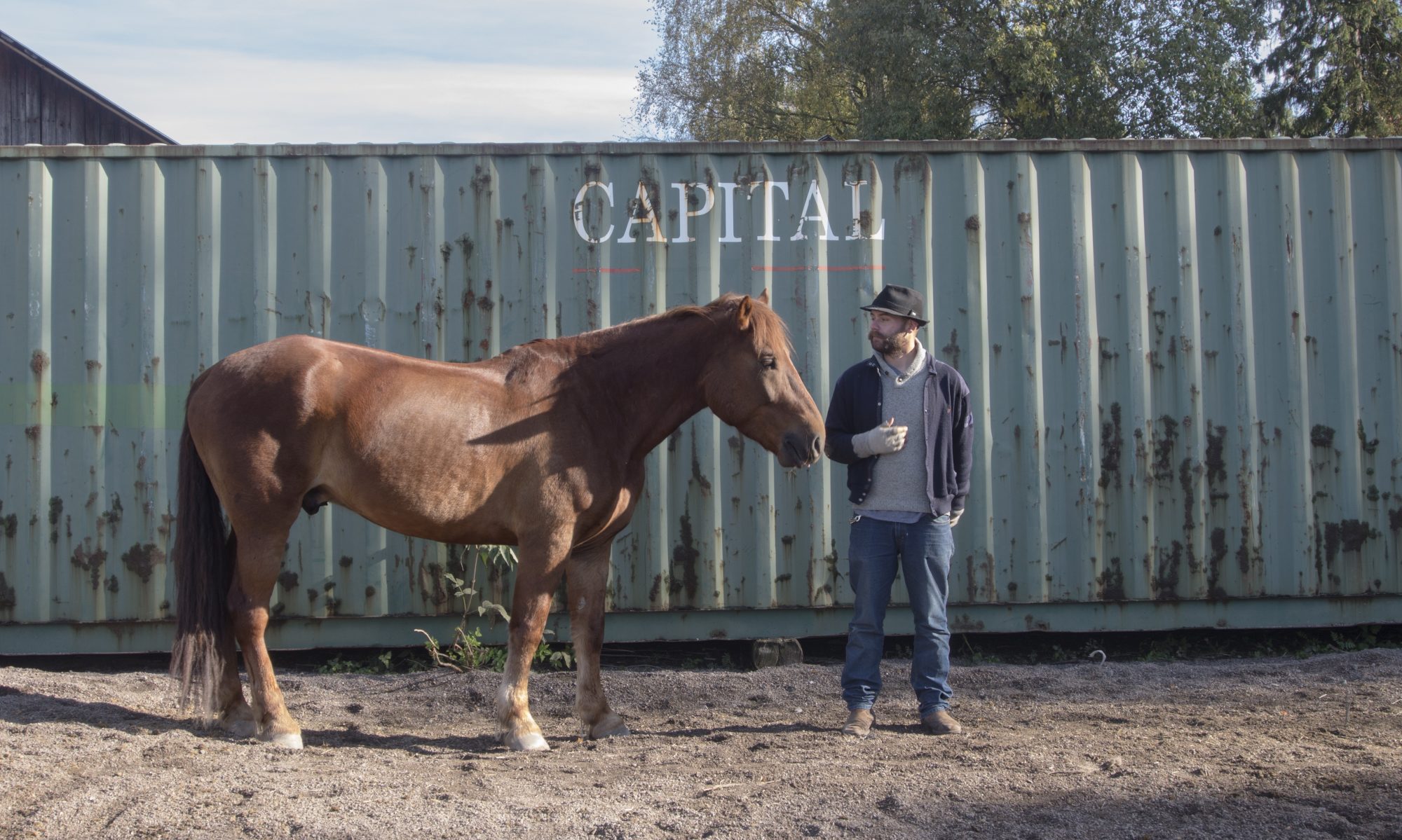
The 90 hour long “Media & Performance” course was organized for the Kankaanpään Art School under the supervision of Aapo Korkeaoja and Matti Velhonoja. Participants learned how to analyze their relationship to technology and to develop their artistic praxis in dialogue with other practitioners. Catarina Pulli, Heikki Korkala, Ilkka Wahala, Karoliina Korvuo, Terho Sulkala and Viljami Nissi co-authored a detailed study journal which is available for download. The group also wrote short texts which examine horses as media by detailing technologies, tools and infrastructure which is used to control and define the animal (See chapter “Horse as a Media” for details). The course materials (3d designs, images and texts) are licensed under: Attribution-NonCommercial 4.0 International (CC BY-NC 4.0).
Download the document: 20170130_media-and-performance_kankaanpaa-art-school.pdf (4,6mb).
20170314
Edits on the SOW: Blacksmith sample pack are progressing steadily and I’ll have all of the samples chopped by the end of the week. After this I’ll continue with mastering. EQ fixes are almost done but the dynamics of some loud machines and hammers pose a challenge. After the fixes I’ll export the samples and continue organizing them into folders and adding metadata. If everything goes as planned we can publish the pack by the end of the month. I plan to make a intro video for the collection at Jesses smithy.
Did some benchmarking and found a few companies and private artists offering blacksmith sounds and other industrial noises for sound designers and musicians. Some of these links have been collected by Paul Virostek who runs the Creative Field Recordings blog.
- Freesound offers 134 sound tagged “blacksmith” for Free!
- Bluezone Corporation offers the “Metal Impact Sound Effects” pack for 14,95€
- Eiravein works offers the “Ilmarinen” Blacksmith sample pack for 16€
- Echocollectivefx’s offers the “Lockdown” sample pack for 40€
- Hart FX offers a massive “Hart of Steel” collection for 99€
Minttu also recommend a Finnish musician who is working with junkyard sounds called Pentti Dassum. He works under the title Umpio and he’s currently engaged in a sounds of craft and labor project related to textiles.
I regret we didn’t use more professional mics for our recordings. The tonality of our samples is suitable for projects that are flirting with lo-fi field recording aesthetics. If we’d invested in more advanced mics we could could have reached out to the professional foley artist community too. Our efforts will provide a great addition to the Freesound community.
Assisted Ilkka Wahala (a graduate from the Kankaanpää Art School) with his real/simulation shooting documentation. He had organized a shooting range, an instructor and guns from Osuva a range located in the center of Helsinki. He shot with a Scorpion Assault Rifle and a pistol. I got to shoot too but only with a training gun. It was fun and the staff was very welcoming. Relatively cheap too.
Meeting Kristian at the gym in preparation of the Kontula Electronic gig.
20170311
Mitä tieteestä jää jäljelle? by Tere Vadén.
Liian vanha esikoisohjaajaksi. a motivational interview of Hannaleena Hauru by Anton Vanha-Vajamaa.
We performed our co-authored song with Vili at his kids name-giving party. Audience reactions were overwhelming (50% kids under 15 years [~8% related to me], 35% parents, 15% dates).
20170309
Can I Get An Amen? (2004) & Bassline Baseline (2005) by Nate Harrison (Note: Bassline Bassline circumvents youtube copyright protection algorithms by randomly gate-chopping samples!). Both pieces are fuelled with technological optimism (which in 2004-5 was already nostalgia). Contemporary discussion concerning cultural appropriation are distant and sampling is presented as a expression of an pancultural youth movement which seeks to discredit capitalism, corporate record labels and mainstream artists (The dismay mainstream artist felt over sampling is well captured in this delightful extract from 1988).
Jon Leidecker’s (aka. Wobbly) podcast series VARIATIONS #1-7 (2009-2012) investigates the history sampling in more detail. In all VARIATIONS is a great introduction to 20th century avantgarde music. He begins the series by illustrating how musical notation and sampling are related. These technologies have enabled artists to extract tunes and forms from localized cultural contexts and to distribute them globally, make remixes, to store tunes/forms indefinitely and to re-listen to tunes/forms without social context. Musical notations is as intrusive as sampling!
Leidecker argues that recorded music gave artists, who didn’t have training in notation the opportunity to document and share their culture. He presents jazz as an artform which developed largely through recordings. Early jazz musicians developed new styles to play old instruments and these styles were shared globally through 78RPM recording (Musical notation struggles to capture the style instruments can be played). Recorded music and samplers returned power to oral cultures and traditions. Charismatic performers who were overshadowed by literary traditions could re-emerge and seek out global audiences.
He presents sampling and remixing as fundamental human rights. As methods for organizing like-minded people. I think he argues that the best way to fight cultural stagnation and alienation (under capitalistic conditions) is to embrace sampling full heartedly. Corporate record labels and centralized regimes will always find ways to appropriate subcultures and minorities – The only way we can overturn such developments is by sampling, sharing and remixing. By using technology to disrupt. The sampler is like nuclear energy – We are all affected by it and it continues to define the world according to its logic (as discussed earlier).
I think many contemporary discussions concerning cultural appropriation are steered by a negative reaction to the technology of the sampler. It’s a convenient adversary. It is technology which is designed to extracts cultural signs away from their native context and to remix samples according to a fixed logic (wester time signatures and scales). But when we are discussing cultural appropriation, it is important to understand the difference between the global impact of the technology of the sampler and individual artists who use samplers. Herbie Hancock believes that samplers are tools which allow users to choose if they are used for good or bad. There is nothing intrinsically bad about technology or appropriation for that matter. Copying successful techniques from other could be considered is a human right and we can’t turn back the clock.
The arrival of samplers have changed our cultural ecology and artists who use them for remixes are trying to adapt to the change. Naïve users get blamed for what our sinister technology enables. It is the sampler in its self which subjugates and quantifies cultural signs accross classes and continents. Everyone touched by its logic has been tainted. #ॐ
We cannot stop sampling as a technological approach to culture – But we can use samplers to connect to each other. Acceleration is the best route for action. We should confront each others and not allow fear to hinder our efforts. Gianni Motti’s HIGGS, looking for the anti-Motti (2005) is a cynical artwork. He should have run together with someone, so that they would have collided and exploded into previously unseen particles.
Samplers are not against local cultures. They are against the world. In the wrong hands samplers are paving way for a granular future, where we cease to form relations to other cultures and only form relations to technology! As Topi discovered, people who use Tinder are actually in relationship with the application and the casual human encounter they engage in are irrelevant for the application developer and the emerging Tinder-culture. Sampler technologies are here: Embrace the possibilities they offer.
I hope the SOW: Blacksmith will manage to build bridges between new and old professions and classes. Designers make techno on their free time… By using samples extracted from the sounds of work of the craftsperson, they can alling their (rhythmically moving) bodies to the the reality of the labor force. We are in this together.